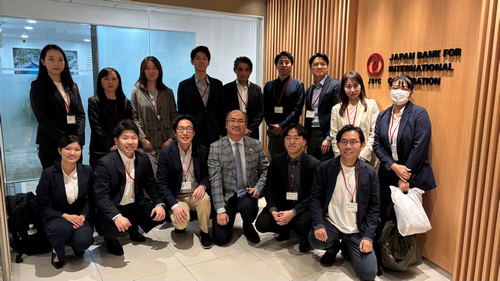
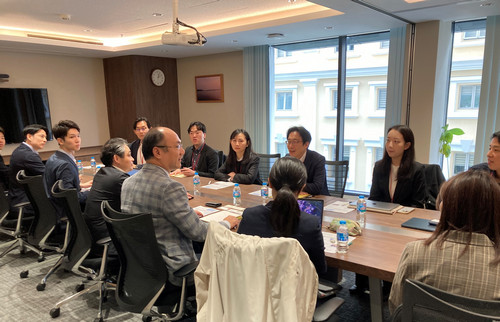
On January 21, the Representative Office in Hanoi of the Japan Bank for International Cooperation (JBIC) received a visit from four faculty members and ten students from the Management Analysis Program of Hitotsubashi University Business School. The office delivered a lecture on Vietnam’s economic and social challenges and on the activities of Japanese companies and JBIC in the country, followed by an exchange of views with the participants.
The Management Analysis Program offers overseas training that enables students to experience economic development firsthand. Through this training, they deepen their understanding of global business expansion and human resource development, and cultivate the skills needed to become future management leaders. This year’s study trip to Hanoi included not only exchanges with Japanese companies, local firms, and universities in the city, but also a visit to JBIC.
In the lecture, Mr. AGUIN Toru, Chief Advisor for Vietnam & ASEAN Regional Partnership and Chief Representative in Hanoi, provided insights drawn from his seven years of experience working in Vietnam. He explained key perspectives for understanding the economic and investment relationship between Japan and Vietnam, including: (1) Vietnam’s rapidly growing economy and the latest trends in investment and trade; (2) the decisive reform stance of the country’s leadership and its policies aimed at becoming a high‑income country by 2045; and (3) the opportunities and challenges that the changing local market environment poses for Japanese companies. He also introduced some of JBIC’s diverse activities, such as leading the Japan–Vietnam public–private energy dialogue and, in collaboration with Japanese regional banks, supporting regional companies in entering the Vietnamese market.
During the Q&A session with students, a wide range of questions were raised from diverse perspectives, including: (1) the driving forces behind Vietnam’s economic growth; (2) the sustainability of Vietnam’s growth and its policy priorities in comparison with China’s past development; (3) areas of interest for Japanese companies in Vietnam’s power and energy development, along with relevant business approaches and challenges; (4) JBIC’s strengths in building and leveraging relationships with the Vietnamese government, compared with those of private companies; and (5) differences in JBIC’s risk-taking approaches and project structuring methods depending on project characteristics. Through the lecture and discussions, it became clear that the students showed keen interest in the business challenges and potential solutions in Vietnam, a country that continues to grow dynamically.
JBIC engages in policy dialogue with host country governments and industry, as well as in project development and research activities, leveraging its extensive local network of overseas offices, including in Vietnam, and continuously accumulates knowledge about each country and region. Using the expertise, JBIC will continue to provide a wide range of information to support Japanese companies in their overseas business development, while actively contributing to the expansion of their global operations and the improvement of the investment environment.