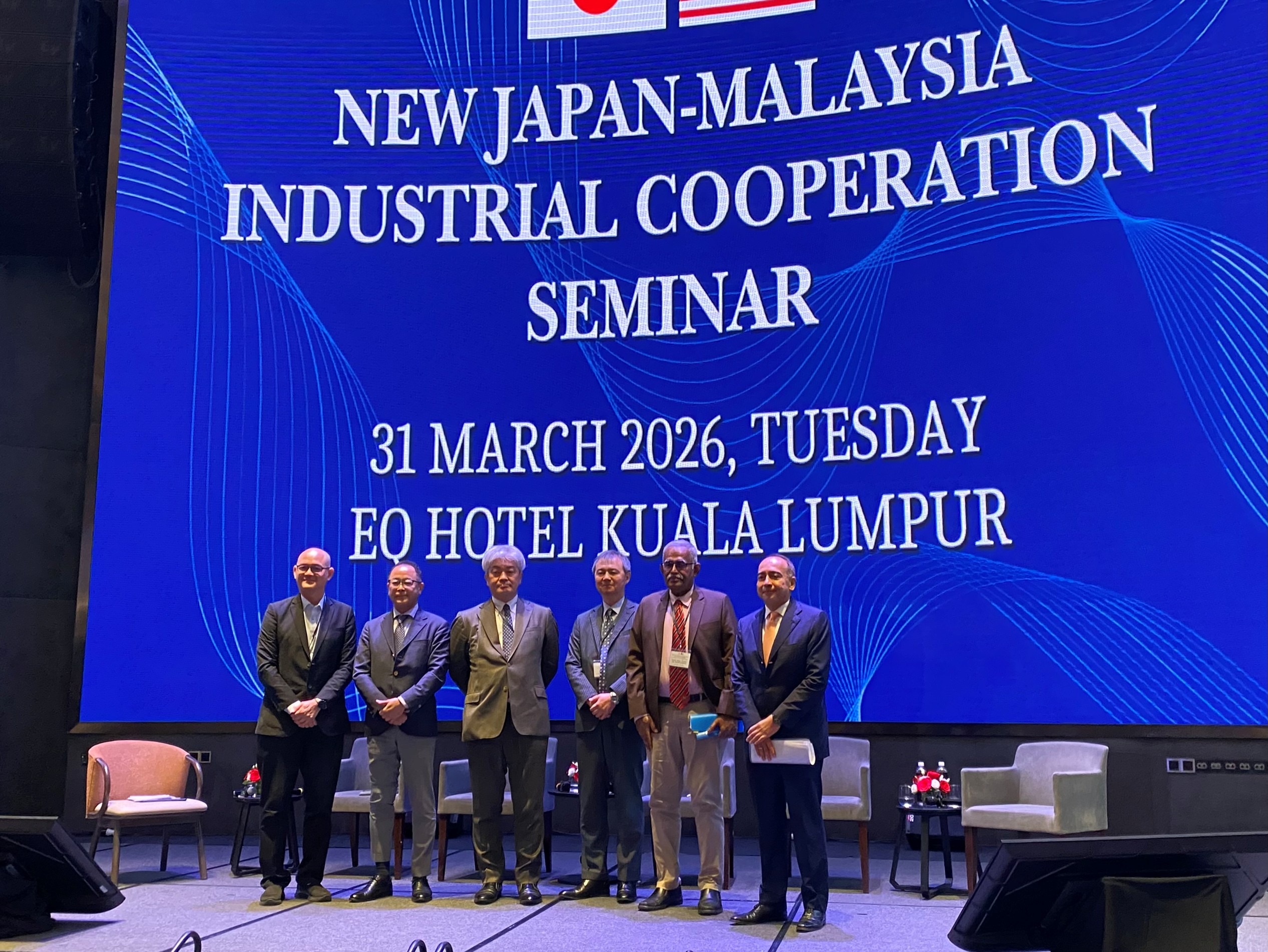
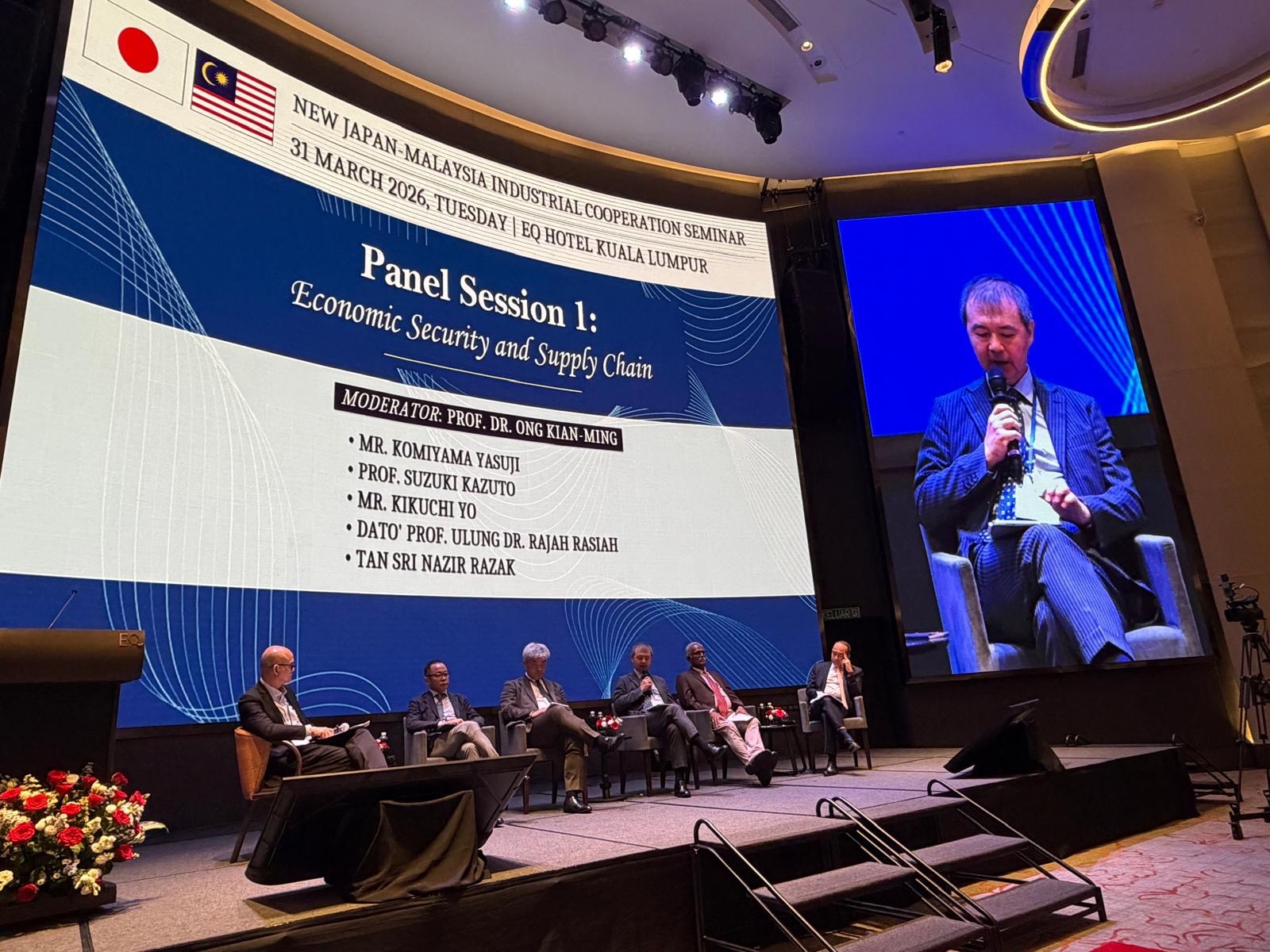
Senior Managing Director KIKUCHI Yo of the Japan Bank for International Cooperation (JBIC) spoke at the New Japan-Malaysia Industrial Cooperation Seminar held on March 31, 2026. The seminar was hosted by the Embassy of Japan in Malaysia to strengthen industrial cooperation between Japan and Malaysia, taking into account the 17 strategic sectors identified by the Council for Japan’s Growth Strategy established under the TAKAICHI administration.
The forum opened with remarks from SHIKATA Noriyuki, Ambassador of Japan to Malaysia, followed by remarks from Sim Tze Tzin, Deputy Minister of the Ministry of Investment, Trade and Industry (MITI), and YM Tengku Datuk Seri Utama Zafrul Tengku Abdul Aziz, Senior Political Advisor to the Prime Minister and Chairman of the Malaysian Investment Development Authority (MIDA), among others. This was followed by keynote speeches and panel discussions featuring leaders from industry, academia, and government in Japan and Malaysia, covering the themes of (1) Economic Security and Supply Chain, (2) Resource and Energy Security and GX (Green Transformation), and (3) AI and Semiconductors.
KIKUCHI spoke at Session (1), “Economic Security and Supply Chain,” and expressed his views on the impact of the current Middle East situation on businesses and nations. He noted that Japan’s dependence on the Middle East for natural gas has been reduced to around 10% as a result of diversification efforts. However, its reliance on the region for crude oil imports remains high at over 90%, and he emphasized the need to diversify crude oil supply sources going forward. He pointed out that Japanese companies recognize supply chain disruptions as a realistic risk, and that in reconstructing supply chains, it will become increasingly important to establish decentralized structures that enable continued operations even in times of crisis. He also referred to Malaysia’s energy and fiscal situation, noting that while the country’s dependence on the Middle East for crude oil is relatively high, it is a net exporter of energy, including natural gas. He further pointed out that Malaysia’s sound fiscal position provides room for policy responses, and expressed the view that the country is in a relatively advantageous position.
Regarding JBIC’s role in industrial cooperation between Japan and Malaysia, he explained that as Malaysia announces industrial promotion policies from a long-term perspective, JBIC’s strength in providing long-term financing can contribute to their implementation. He also noted that JBIC not only provides direct financing and investment, but also delivers solutions to host country governments and companies and creates business opportunities for Japanese firms by engaging from the planning and early stages of projects. As specific examples, he introduced a workshop on the development and enhancement of domestic and international power transmission networks co-hosted with Tenaga Nasional Berhad in December 2024, as well as a workshop on CO2 capture and storage (CCS) co-hosted with Petroliam Nasional Berhad (PETRONAS) in February 2026.
As Japan’s policy-based financial institution, JBIC engages in policy dialogue with host country governments and industry and in project development and research activities, and continuously accumulates knowledge about each country and region. Leveraging this knowledge, JBIC will continue to proactively contribute to the overseas business expansion of Japanese companies and the improvement of the investment environment.