



Feature ArticleCORPORATE STRATEGY AMID GEOECONOMIC RISKS
As the global order appears to be in transition, alliances shift and the economic interdependence that once promised peace is weaponized, geoeconomics and security specialist Dr. Niklas Swanström delivers his take on how the world is evolving and how Japan can adapt to it.
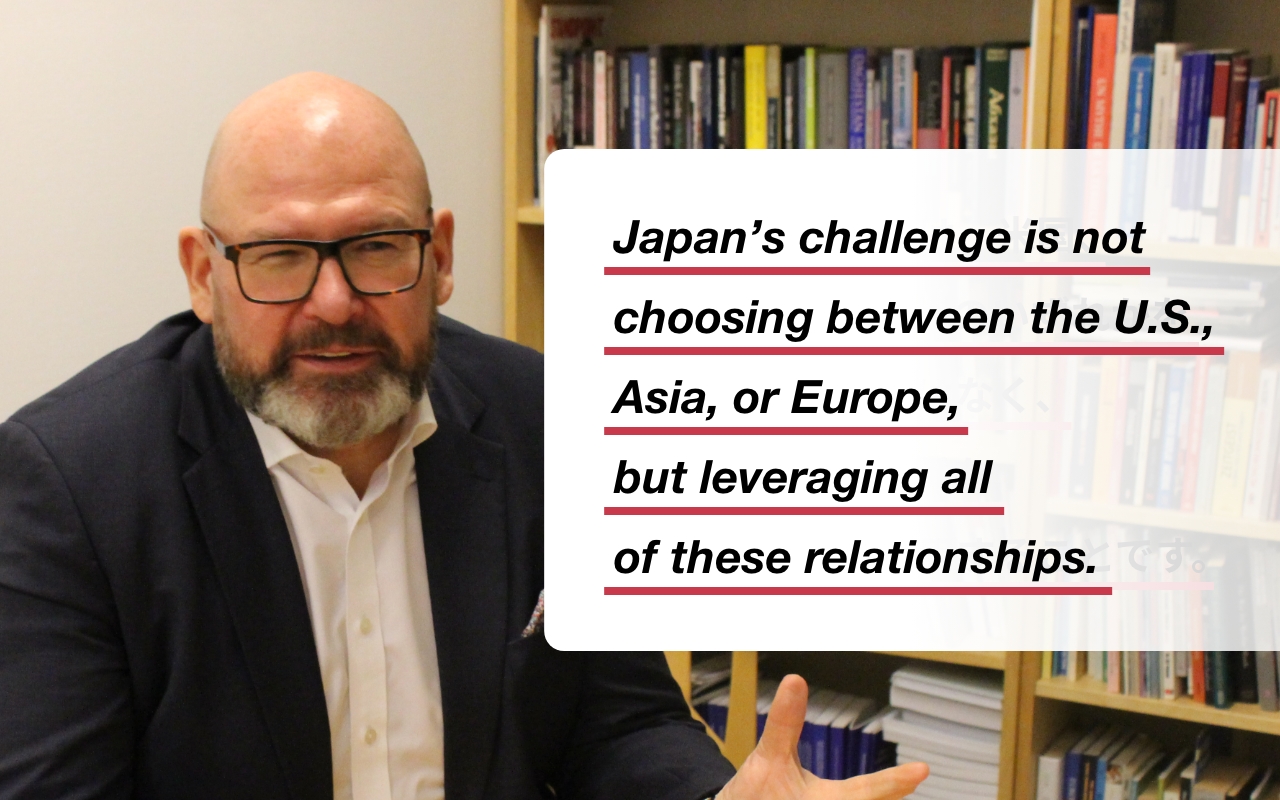
Director and co-founder of the Institute for Security and Development Policy Niklas Swanström In addition to a PhD from Uppsala University, MAs from Uppsala and Fletcher School of Law and Diplomacy, and extensive study in China, Dr. Niklas Swanström is the director of the Sweden-based Institute for Security and Development Policy. He has authored and contributed to multiple books on topics including supply chain security, non-traditional security threats such as cyber warfare and disinformation, Chinese foreign policy, Northeast Asian geoeconomics and geopolitics, as well as conflict prevention and management.
 Looking ahead, how do you see security dynamics evolving across Europe, North America, and Asia this year?
 Unpredictability is the key word. We are entering a period with a new set of synchronized challenges where security, economics, and politics are deeply intertwined in ways we haven't seen before. Traditional alliance lines are weakening, at least temporarily, and countries will need to diversify their partnerships. Paradoxically, this will lead to greater polarization but also greater multipolarity, as states focus more on their own security and resilience.
We are already seeing shifts in trade and political alignment. How significant are these changes?
They are very significant. The way that the U.S. is viewed by its allies has been altered, even if the U.S. remains the most important security provider for Europe, Japan, and South Korea. We are seeing Europe and parts of Asia gradually turn away from overreliance on the U.S. market. Consumers and companies are beginning to make different choices, and China becomes an increasingly important—if complex—economic partner.
What does this mean for supply chains and economic security, particularly for Japan and Europe?
Diversification is no longer optional. Japan and Europe are already exposed to economic coercion by the major powers, whether through export controls, tariffs, or restrictions on critical minerals such as gallium, germanium, and graphite. The challenge is that diversification is constrained: alternative markets and suppliers are often already influenced by major powers, and they could be hit with sanctions over their dealings with other nations. Still, relying on a single economic actor is a serious national security risk.
Many people once believed that economic interdependence would reduce conflict. Has that assumption been proven wrong?
Largely, yes. Economic interdependence has increased wealth, but it has also created vulnerabilities that can be weaponized. We now see trade, investment, and regulation used as tools of coercion. This doesn't mean decoupling is realistic or desirable—complete decoupling has never happened, even during the Cold War—but it does mean we need to rethink how dependence is managed.
Is it realistic for Europe or Japan to reshore production in areas like solar panels?
It is technically possible but extremely costly. Building full domestic capacity for solar panels would require enormous investment and time, while governments are simultaneously increasing military spending. The real challenge is prioritization: deciding which technologies and sectors are critical enough to justify the cost, and whether consumers are willing to accept higher prices. Awareness matters a great deal.
In Europe, the Russian invasion of Ukraine increased public willingness to accept higher costs for energy and security. A similar shift could occur in Japan if there were a crisis over Taiwan. Still, resources are limited, and governments face difficult trade-offs.
Japan is often described as a linchpin of security in the Asia-Pacific. How can it balance its alliance with the U.S. while maintaining regional ties?
Japan's challenge is not choosing between the U.S., Asia, or Europe, but leveraging all of these relationships. Diversification is essential—toward Southeast Asia, Central Europe, Latin America, and beyond—but it must be strategic, not scattershot. Priority regions such as Vietnam, parts of Central and Northern Europe, and countries like Mexico and Brazil offer opportunities. The goal is risk reduction through a balanced portfolio.
What are some common misconceptions around geopolitical and geoeconomic risks?
One major misconception is that geopolitical risk is only for governments to manage. In reality, companies—especially mid-sized firms—are often the first targets. Another is the belief that diversifying away from China automatically solves the problem. Many alternative suppliers are still dependent on China.
There is also a false sense of security around specialization or long-term business relationships; these do not protect firms from political pressure. Military conflict is sometimes overestimated. While risks around Taiwan or the Korean Peninsula are serious, they are often managed more carefully than headlines suggest. At the same time, non-military risks—cyber threats, legal and regulatory weaponization, disinformation, and climate-related disruption—are often underestimated.

Non-military risks such as cyberattacks and the spread of disinformation are increasing alongside conflicts.
What should JBIC focus on in this shifting environment?
JBIC should be seen not just as a development bank but as a strategic tool for Japan's economic security. That means prioritizing critical sectors—semiconductors, advanced materials, batteries, digital infrastructure, pharmaceuticals, space and satellite systems—and critical regions.
It also means developing stronger geopolitical risk assessment frameworks, including hybrid threat indicators and supply-chain resilience metrics. JBIC also needs to adjust how it evaluates risk and success. Traditional development metrics are no longer sufficient. Strategic value—how a project contributes to Japan's long-term competitiveness and security—has to carry much greater weight alongside commercial viability. This may require a higher risk tolerance and new financing tools, such as enhanced political risk insurance and support for consortium-based investments that allow Japanese firms to share exposure.

How should JBIC and similar institutions think about international law, given its apparent weaknesses?
We can no longer assume that international law alone will protect investments. It relies heavily on consensus, and enforcement is weak against powerful states. Japan and Europe do not have the military leverage to ignore international rules—precisely why those rules matter so much to us. The response should be deeper collaboration among countries that do value predictability and rules.
That includes coordinated approaches to standards-setting in emerging technologies and closer ties between development banks, export credit agencies, and regional institutions such as the African Development Bank or the Inter-American Development Bank. And we need to be realistic: multilateral institutions like the UN and WTO are flawed and often ineffective, but remain our only global frameworks. Strengthening them, even incrementally, is still preferable to letting them erode entirely.

