Feature ArticleCORPORATE STRATEGY AMID GEOECONOMIC RISKS

Addressing unpredictable geopolitical risks requires a perspective that factors in both global economic trends and country-specific financial risks.
Delivering integrated information analysis and financial assessments, JBIC supports Japanese companies in their decision-making amid a rapidly changing international environment.
Analysis is underpinned by staff from diverse backgrounds who continually examine issues from multiple perspectives while formulating and testing hypotheses.
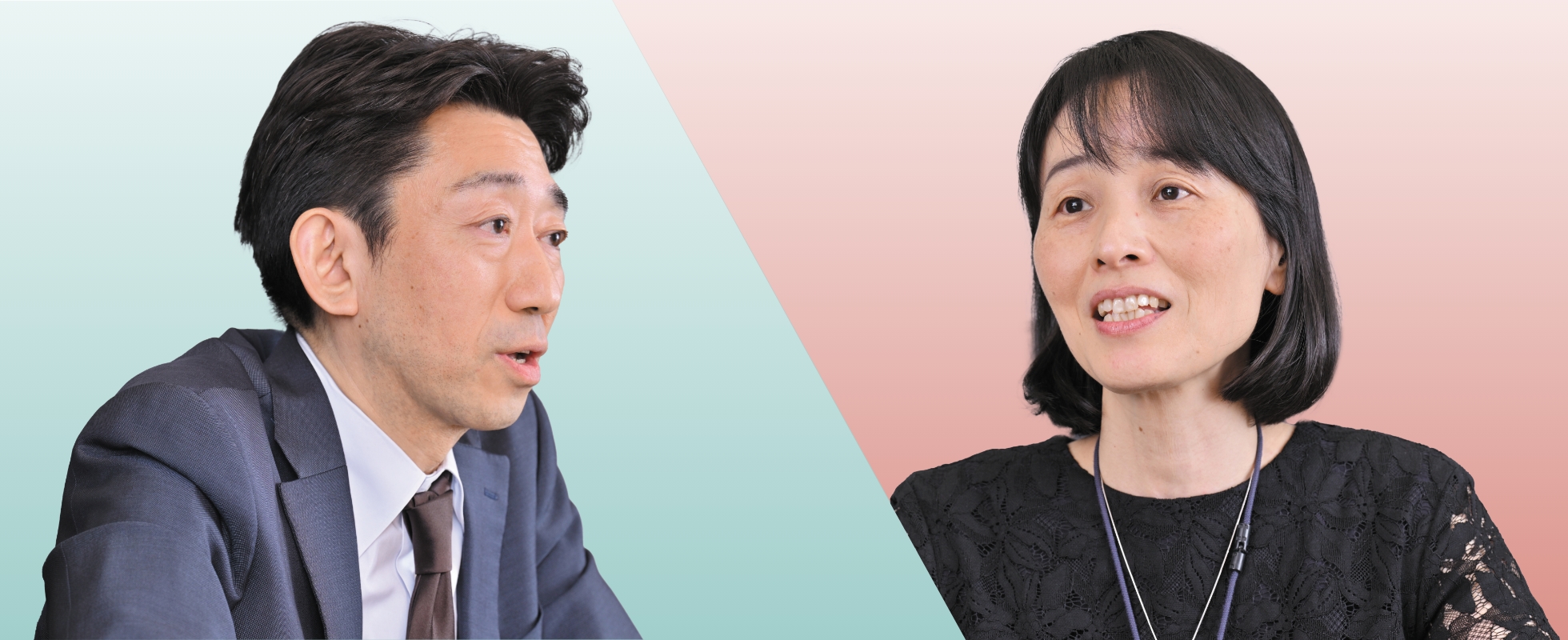
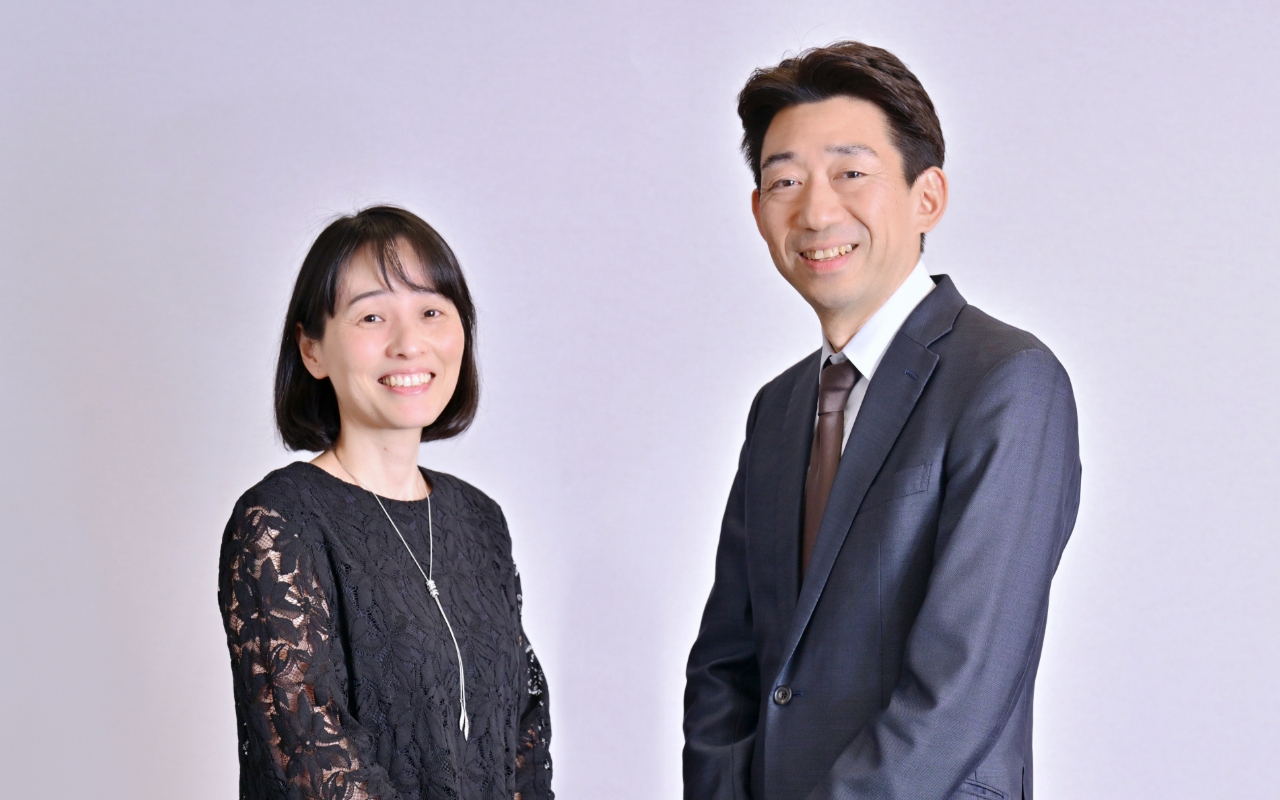
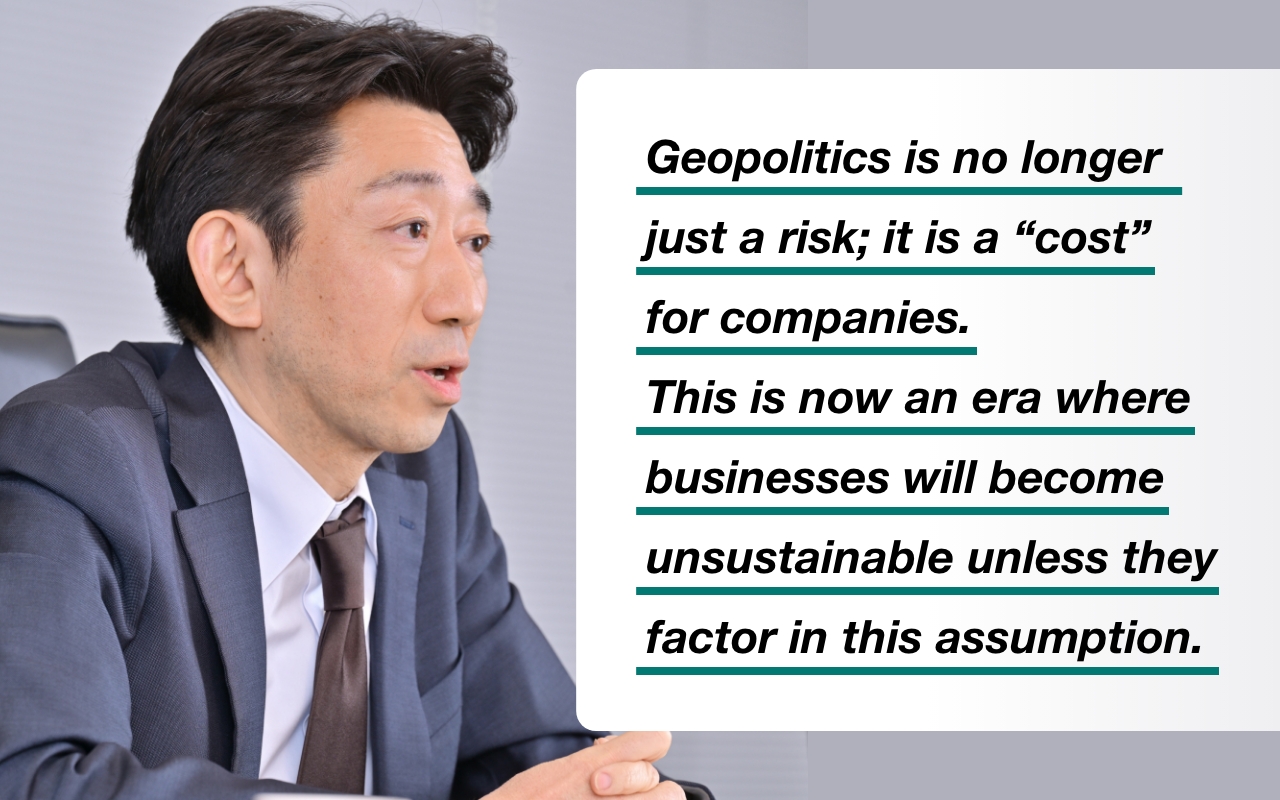
(left) Managing Officer and Director General of the Strategic Research Department, JBIC KAWAKAMI Nao Joined the bank in 1996. After working in areas including resources and energy, infrastructure finance, and corporate planning, he was appointed Chief Representative of the Representative Office in Washington, D.C. Managing Officer and Director General of the Strategic Research Department since 2024. Graduated from the University of Tokyo, Faculty of Law, and has a master's degree (LLM) from the University of Michigan (Ann Arbor) Law School.
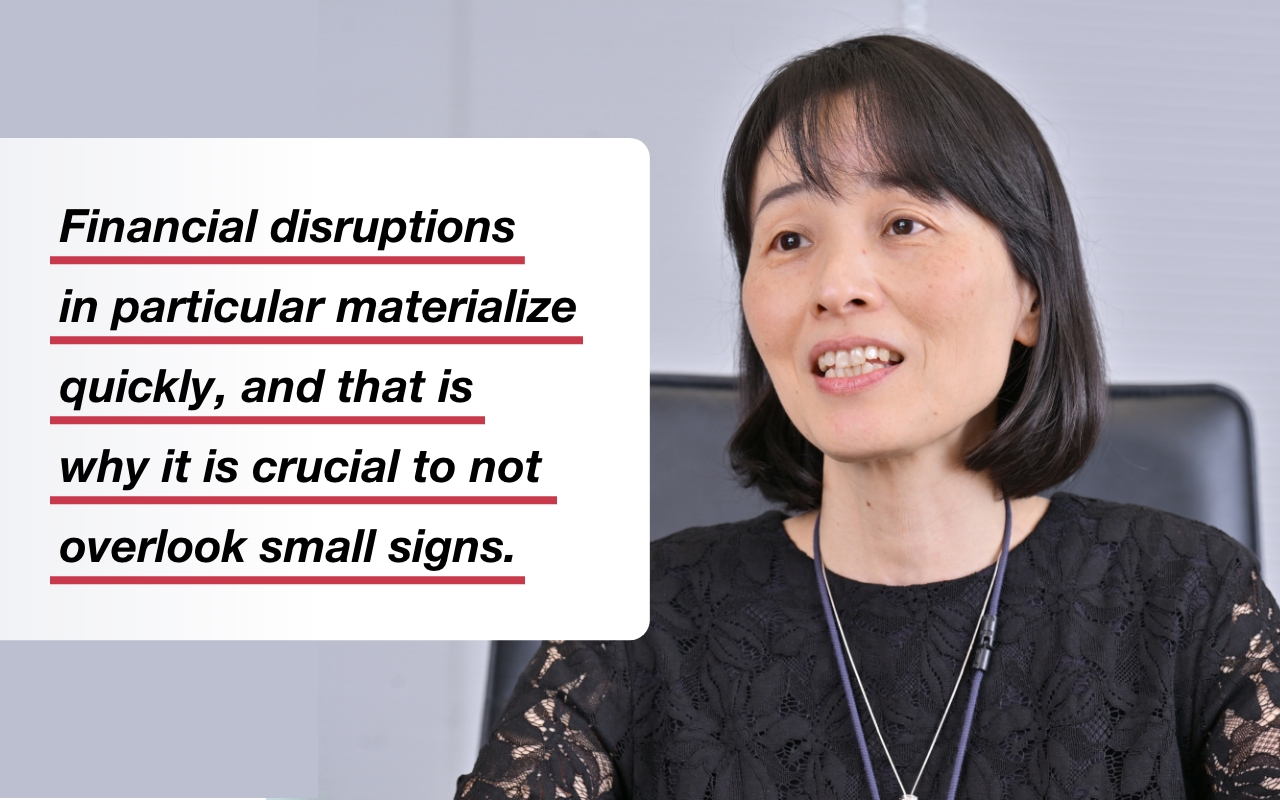
(right) Managing Officer and Director General of the Country Credit Department, JBIC YOKOBORI Naoko Joined the bank in 1997. After assignments including secondment to the IMF, Senior Representative of the Representative Office in Paris, and secondment to the Cabinet Secretariat, she was assigned to sovereign risk assessment in the Country Credit Department. Has been Managing Officer and Director General of the department since 2024. Graduated from the University of Tokyo, College of Arts and Sciences, and has a master's degree (MA) in International & Development Economics from Yale University.
The Strategic Research Department and the Country Credit Department are the two "brains" of JBIC. Amid escalating uncertainty over the international situation and the accelerating pace of change, these two departments cooperate to serve as a compass guiding Japanese companies. KAWAKAMI Nao, Managing Officer and Director General of the Strategic Research Department, and YOKOBORI Naoko, Managing Officer and Director General of the Country Credit Department, share how the two departments collaborate and analyze geopolitical risks.
── What are the respective roles of the two departments?
KAWAKAMI The key difference lies in the perspective each department is responsible for. The Strategic Research Department is part of the Corporate Planning Group. Rather than being directly tied to individual projects, its role is to identify major currents, such as geopolitical, industrial, and technological trends, and to share these insights with JBIC's management and Japanese companies.
YOKOBORI The Country Credit Department comes under the Credit, Assessment and Risk Management Group. While keeping individual transactions in mind, we analyze international financial markets and country-specific economic conditions that form the backdrop to JBIC lending activities and project management. Our core responsibility is assessing sovereign risk—a country's repayment capacity. Drawing on the Strategic Research Department's analysis of how broad currents such as geopolitical and technological trends affect the global economy and specific countries, we apply those insights to transaction appraisal and risk management.
── Have your two departments always worked closely together?
KAWAKAMI The Strategic Research Department is a relatively new department established about eight years ago. It's only been a few years since we began working with the Country Credit Department as closely as we do today. The driver was the growing complexity of international analysis, making it increasingly important to consider a single phenomenon from multiple perspectives.
YOKOBORI Requests from senior management for timely input have increased significantly compared with the past. By deepening cooperation, we feel that the organization as a whole has gained the ability to conduct more multifaceted analysis. The Strategic Research Department and the Country Credit Department hold regular discussions to align our views on how to interpret events occurring in the world.
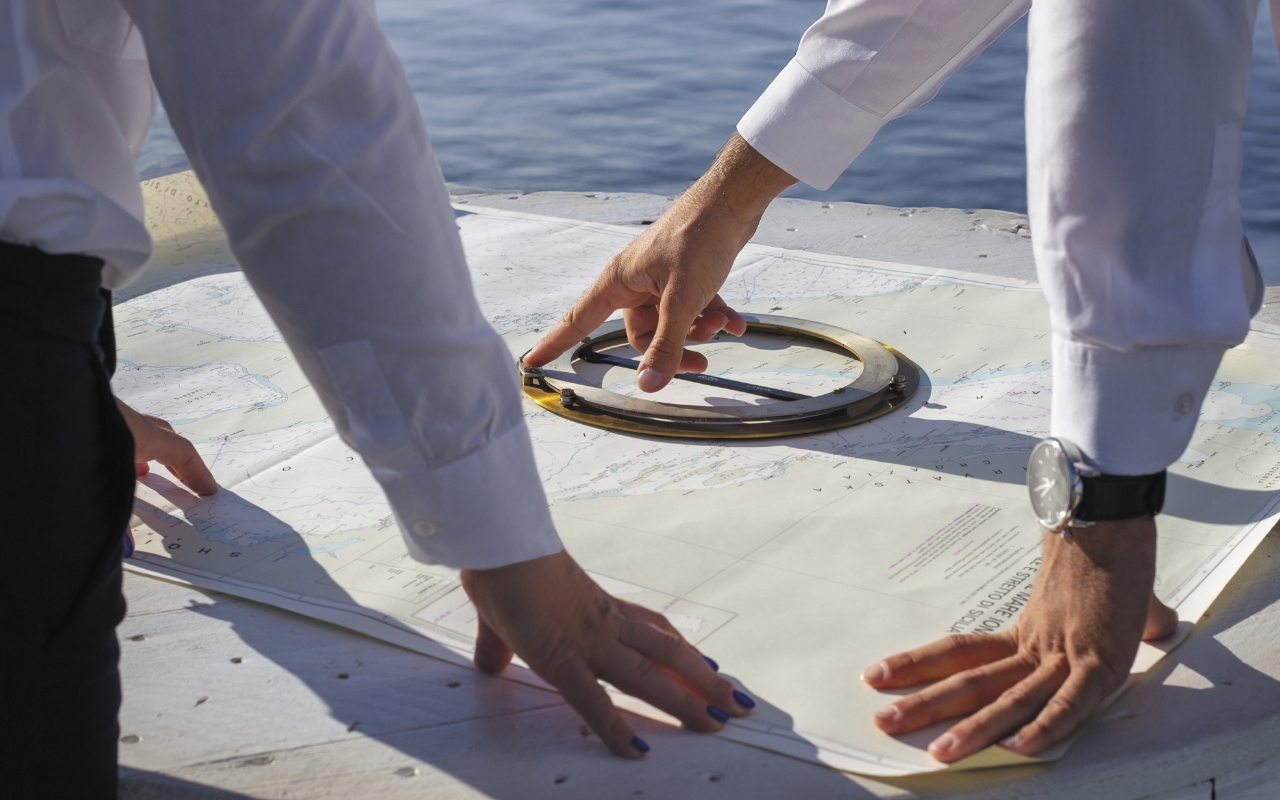
Analysts from the Strategic Research Department and economists from the Country Credit Department, routinely engage in frank discussions from their different perspectives to explore the direction of their analyses.
── What is your take on current geopolitical and geoeconomic risks?
YOKOBORI I feel that the era of unwavering trust in international rules and free trade has come to an end. International organizations such as the International Monetary Fund (IMF) had traditionally led restructuring based on established rules when an emerging country faced a financial crisis, but it is now becoming difficult for such frameworks to function. For emerging economies, their geopolitical positioning—namely, which countries or blocs, such as the U.S. or China, they choose to deepen ties with for financing and diplomatic relations, is now a crucial factor influencing their repayment capacity.
KAWAKAMI Geopolitics used to be a subject limited to just some experts and specific high-risk regions. That's no longer the case. This concept has infiltrated all economic activities including trade, investment, supply chains, semiconductors, and cutting-edge technologies. Economic activity and national security used to be separate, but they now overlap in this era of "economic security."
Lately, I have been saying that "geopolitics is no longer just a risk; it is a 'cost' for companies." I see the world as having become one where businesses must factor in some costs to be sustainable in this age of uncertainty.
── What does each of your departments prioritize when collecting and analyzing information?
KAWAKAMI I encourage analysts in the Strategic Research Department to follow three steps: "fact-finding," "analysis of background and cause," and "implications for the future," and then present it as a coherent narrative. Geopolitical analyses tend to be qualitative, but we always back this up with quantitative proof—data and figures to make our message more persuasive.
YOKOBORI A defining feature of analyses by the Country Credit Department is "multi-layered interviews." We not only engage with a country's government and central bank, but also with private financial institutions, Japanese companies operating in the country, and even international organizations and think tanks, for a multifaceted assessment of the country's situation within the broader sweep of the global economy.
── Are there warning signs when assessing risk?
YOKOBORI We focus on two key channels: first, the real-economy channel, such as how tariff policies affect exports and investment; and second, the financial channel, such as how rising U.S. long-term interest rates increase financing costs for emerging economies. Financial disruptions, in particular, can materialize very quickly. That is why continuous monitoring of financial markets and early detection of even small signs of stress are essential.
KAWAKAMI I frequently exchange views with external experts. When their opinions all point in the same direction, I get very skeptical, because sharing the same outlook tends to reduce sensitivity toward changes in underlying assumptions. Conversely, when views diverge, the uncertainties come into sharp relief, making it easier to catch the early signs of risk.
YOKOBORI I believe it to be most dangerous when there is a clear problem, but political constraints prevent necessary measures from being taken. For example, when policy response lags, such as not increasing exchange rate flexibility when foreign exchange reserves are being depleted, the risk of default increases.
Using the combination of diverse data and local information, risk is analyzed by country and project for financial decision-making.
── How do you view the challenges faced by Japanese companies looking to expand overseas?
KAWAKAMI Withdrawal from overseas operations and restructuring of supply chains due to geopolitical risks are becoming increasingly widespread. While companies essentially formulate their business strategies on the premise of long-term predictability, geopolitical risks are the exact opposite, changing unpredictably over the short term. I believe that the largest issue is this temporal gap.
There are also many companies that lack the talent and expertise to analyze these risks. This is more of a challenge confronting Japan as a whole, rather than individual companies. That is why we want to provide companies with the information we analyzed through our extensive networks. I believe that JBIC's greatest strength lies in our ability to provide information and analyses, and financial solutions (e.g., loans and equity investments, and guarantees) based on that, as one package.
YOKOBORI Recently, we have increasingly been consulted on how JBIC views countries in high-risk regions such as the Middle East and Africa. By combining on-the-ground intelligence from our 18 overseas representative offices with a broader macro perspective encompassing both the global economy and the overall economy of the respective countries, we aim to effectively support Japanese companies in their decision-making processes.
── What kind of people do you think are suited for this type of analytical work?
KAWAKAMI I think they are people who have an intellectual curiosity and the ability to formulate hypotheses. The Strategic Research Department has more than a few people who were science majors. From the enormous amount of news and data, they formulate a hypothesis and verify it through interviews and other methods, and accumulate evidence for an analysis. Scientific thinking skills are extremely useful in this process.
YOKOBORI People who genuinely enjoy thinking about how daily news affects the global economy and their assigned countries. A basic understanding of economics is essential, but backgrounds can be diverse. By pooling individual strengths, we will continue to pursue multifaceted country analysis.