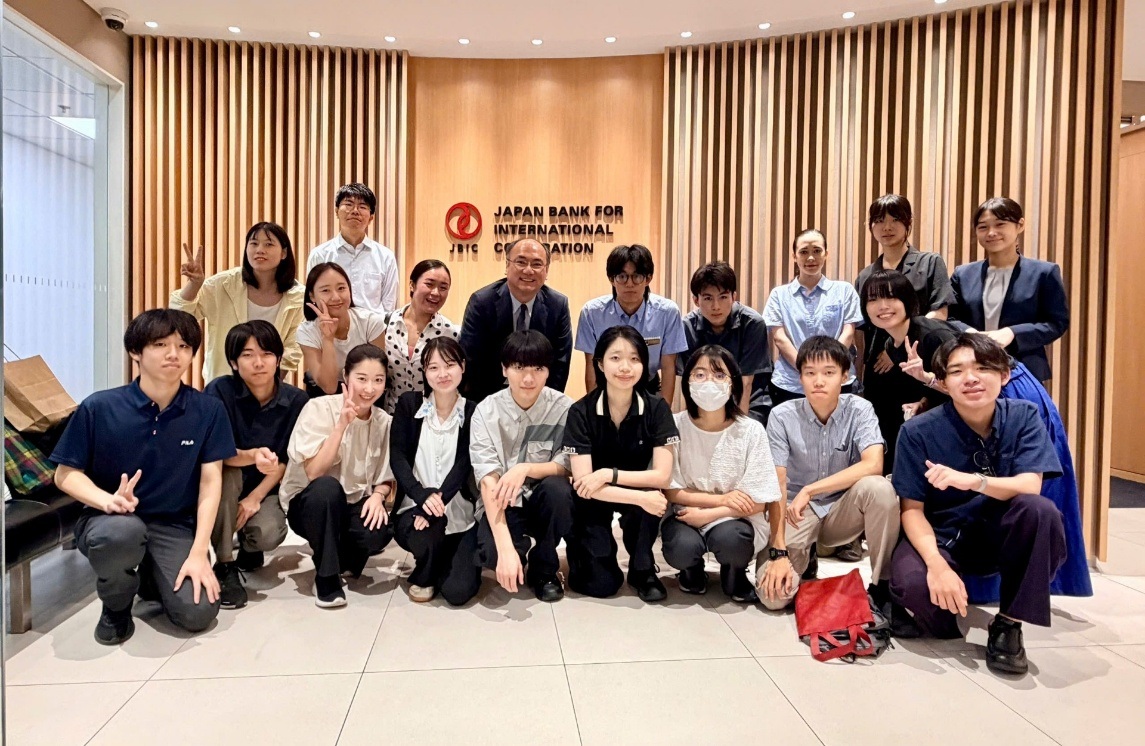
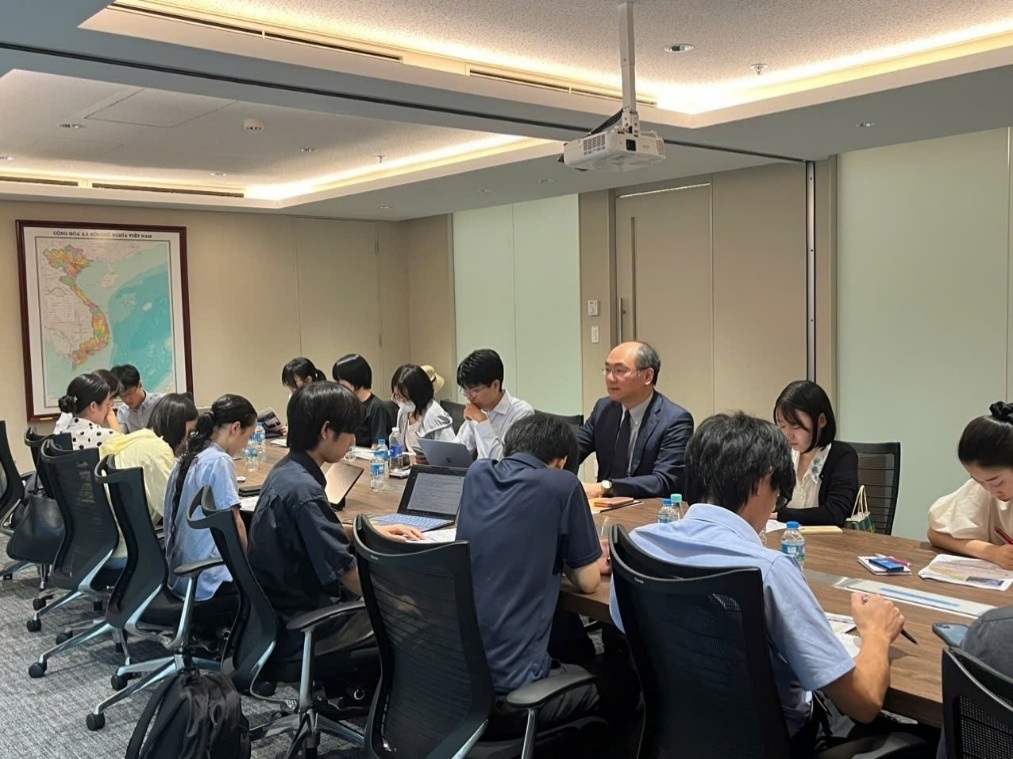
On August 21, 2026, the Representative Office in Hanoi of the Japan Bank for International Cooperation (JBIC) welcomed 18 undergraduate and graduate students from the University of Tokyo. The office delivered a lecture on Vietnam’s economic and social challenges and on the activities of Japanese companies and JBIC in the country, followed by an exchange of views with the students.
Background
Since FY2012, the University of Tokyo has implemented its Hands-on Activity Programs, experiential learning programs that provide students with opportunities to experience cultures and values different from their own. Vietnam is one of the destinations for these international exchange activities. As part of the FY2026 Hanoi program, students visited Japanese companies, public institutions, Hanoi Law University, and other local facilities. This marked the second visit by students from the University of Tokyo to the Hanoi Representative Office, following a visit in FY2025.
Proceedings
In the lecture, Mr. AGUIN Toru, Chief Advisor for Vietnam & ASEAN Regional Partnership and Chief Representative in Hanoi, explained several key perspectives for understanding the economic relationship between Japan and Vietnam based on the insights he gained during his seven and a half years stationed in Vietnam. Using a wide range of examples, he discussed: (1) Vietnam’s rapidly growing economy and the country’s attractiveness as a destination for Japanese companies; (2) the country’s new policies aimed at achieving high-income status and the challenges faced by Japanese companies; and (3) JBIC’s efforts to improve the investment environment and support energy projects in Vietnam through its leadership of the Japan–Vietnam public–private dialogue under the Asia Zero Emission Community (AZEC) platform.
During the Q&A session with students, a wide range of questions were raised from diverse perspectives. The questions included how JBIC takes into account both Vietnam’s development needs and Japan’s economic interests when making decisions on infrastructure financing; what key points JBIC’s overseas office representatives consider when building trust with the country’s local governments and foreign-owned companies through negotiations; and what makes JBIC’s work rewarding in ways that differ from work at private financial institutions. These questions highlighted the students’ strong interest in JBIC’s activities.
After the lecture, the students also provided comments that showed their clearer and deeper understanding of Vietnam’s current circumstances and challenges, as well as how Japanese companies and public institutions, including JBIC, work on the country’s projects. Below are some of the students’ comments:
- I was so grateful for the opportunity to gain a comprehensive understanding of Vietnam’s economic, diplomatic, and political landscape. In particular, the discussion of government perspectives over the longer term, from the pre-COVID period through the pandemic and into the present, was both insightful and informative.
- The lecturer clearly explained Vietnam’s diplomatic and economic potential using graphs, which helped deepen my understanding of the country. Specifically, I learned the roles that Vietnam and JBIC should play in helping the country avoid the middle-income trap through practical discussions.
- Hearing directly from JBIC representatives involved in local projects helped me better understand Vietnam’s characteristics and challenges, as well as the situation of Japanese companies, through both qualitative and quantitative data drawn from JBIC surveys. This offered me a huge opportunity to learn how companies strategically operate their businesses in a country where its legal system is not yet developed as well as that of Japan, which was very interesting.
- I was struck by the perspective unique to a policy-based financial institution when making financing and investment decisions, particularly the emphasis placed on Japan’s national interests and long-term future. The lecture included many examples, which helped me see how abstract problems are transformed into structured, practical action plans. In particular, the approaches to energy and zero-emission initiatives left a strong impression on me.
JBIC engages in policy dialogue with host country governments and industries, as well as in project development and research activities. In doing so, it has deepened its understanding of each country and region through its extensive local network of Overseas Representative Offices. Leveraging this insight and network, JBIC will continue to provide Japanese companies with a wide range of local information and advice, as well as financial support, and share knowledge with students and university stakeholders. Through these activities, it will serve as a bridge for strengthening economic and investment ties between Japan and host countries, including Vietnam.