




In order to fulfill its policy mandate by providing long-term, large-scale financing and risk capital, JBIC requires a robust and sustainable financial foundation. Through ongoing dialogue with the markets, the Treasury and Systems Group raises funds in a flexible and stable manner, while appropriately managing risk and returns and working to further strengthen JBIC’s financial soundness. Underlying these efforts is the principle that our role is not merely to secure stable funding, but also to maintain and enhance the earnings capacity needed to support the risk-taking expected of a policy-based financial institution through proactive risk management. We believe that this robust financial foundation underpins JBIC’s value creation and serves as the cornerstone enabling us to contribute to growth and stability in Japan and the international community.
In FY2025, the second fiscal year of the Fifth Medium-Term Business Plan, the political and economic frameworks built on the post-Cold War international order came under increasing strain. Against this backdrop, financial markets experienced periods of instability amid changes in U.S. trade policy and heightened geopolitical risks. Even in such an environment, JBIC closely monitored trends in foreign-currency funding costs as a top risk. To address this, we successfully reduced funding costs and diversified funding maturities through various measures, including the issuance of medium- and long-term U.S. dollar-denominated bonds and green bonds, alongside the use of yen-to-foreign-currency swaps. As a result, we were able to maintain and strengthen a stable and diversified funding base while responding flexibly to changes in market conditions. We also steadily strengthened our financial and accounting infrastructure from a medium- to long-term perspective, including by preparing for new accounting standards and developing a framework for local-currency-denominated financing.
FY2026 will be the final year of the Fifth Medium-Term Business Plan. As the international order continues to evolve and uncertainty continues to rise, JBIC is expected to respond more flexibly and strategically to global challenges and needs, including the realization of a decarbonized society, the strengthening and creative reform of Japanese industry, and support in local-currency-denominated financing in several countries and regions. In particular, our role is becoming increasingly important in the field of economic security, as exemplified by the Strategic Investment Initiative under the tariff agreement between the Governments of Japan and the U.S. To meet these policy demands, a financial foundation capable of continuously supporting the necessary risk-taking while utilizing a diverse range of financial instruments is essential. We will promote integrated initiatives in close collaboration with the business departments, while continuing careful dialogue with market participants and accurately assessing market conditions. Through these efforts, we will further enhance financial management that combines soundness with agility and strengthen the financial foundation needed to sustainably fulfill the risk-taking function expected of a policy-based financial institution.
Even in an environment where uncertainty has become the norm, we believe that the mission of the Treasury and Systems Group is to sustain JBIC’s ability to fulfill its role through financial management grounded in a long-term perspective, while maintaining and strengthening the foundation that enables the creation of policy value. We will continue to live up to the confidence placed in us by our stakeholders and contribute to JBIC’s sustainable value creation.
Global Head of Treasury and Systems Group
SUZUKI Ryuta
Basic Policy
- In light of the role expected of JBIC by society and its clients, JBIC will ensure stable fund procurement and effective cash management to continue supporting projects of high policy significance over the long term, while responding promptly and flexibly to changes in the international community and markets
- To ensure an adequate supply of risk capital, JBIC will maintain an autonomous profit structure at a sufficient level to enable it to fulfill its policy role even in a highly uncertain environment, and strengthen its capital base, thereby securing a strong financial foundation and financial soundness
Awareness of Current Conditions
In recent years, uncertainty surrounding the global economy has increased, as policy measures adopted by countries, including trade policies, have affected the very foundations of trade and investment structures and international relations.
Against this changing backdrop, initiatives by Japanese companies to preserve the global environment, including decarbonization, strengthen supply chain resilience, and expand high-quality infrastructure overseas have become even more important from the perspective of economic security. Furthermore, a growing number of initiatives are being implemented, such as the promotion of strategic investment based on policy agreements between governments, that are larger in scale, longer in duration, and require more assured execution than ever before. Addressing these issues requires the provision of long-term, stable financing.
As a policy-based financial institution that is entrusted by the Government of Japan and citizens, JBIC has an important role to play in supporting these areas. To fulfill this role, JBIC requires a robust financial foundation that enables it to continue providing financing of the necessary scale when needed, even during periods of market volatility.
In particular, many of JBIC’s loans have maturities exceeding five years, and approximately 90% of its loan assets are denominated in foreign currencies. Accordingly, the stable procurement of long-term foreign-currency funding matched to the maturities of its loans serves as an essential foundation for JBIC’s role as a policy-based financial institution.
Recently, in addition to inflation trending upwards and switches in monetary policy, geopolitical tensions are increasing in several regions including the Middle East, and the outlook for financial markets has become increasingly uncertain. Despite this situation, JBIC strives to accurately ascertain the market environment through ongoing dialogues with investors, financial institutions, and other market participants around the world. JBIC also raises foreign-currency funds in a flexible and stable manner by combining a diverse range of funding methods, primarily the issuance of government-guaranteed foreign currency bonds, together with currency swap transactions and borrowings from the Government of Japan.
Through these efforts, JBIC maintains the financial foundation necessary to provide long-term, large-scale financing. Leveraging this financial foundation, JBIC will collaborate with Japanese companies and others engaged in overseas business as a policy-based financial institution connecting Japan with the world, as well as the public and private sectors, to address policy issues and create sustainable value.
Consolidated Operating Results and Financial Condition
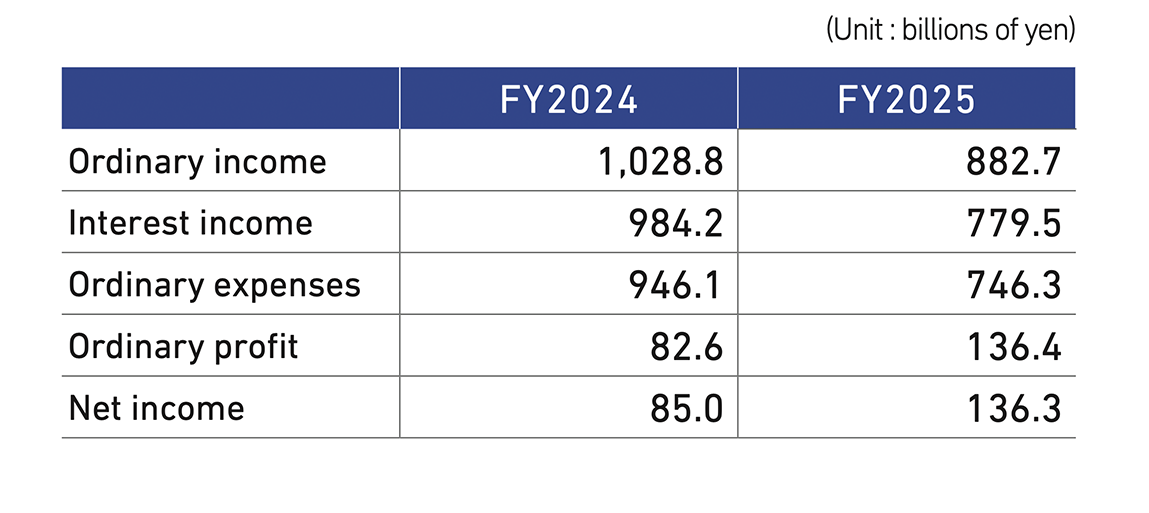
In FY2025, ordinary income decreased by ¥146.0 billion from the previous fiscal year, primarily due to lower U.S. dollar interest rates and a decline in the outstanding balance of loans. On the other hand, ordinary expenses decreased by ¥199.8 billion due to lower financing costs, with both ordinary profit and net income exceeding ¥100.0 billion.
●Consolidated Statements of Operations
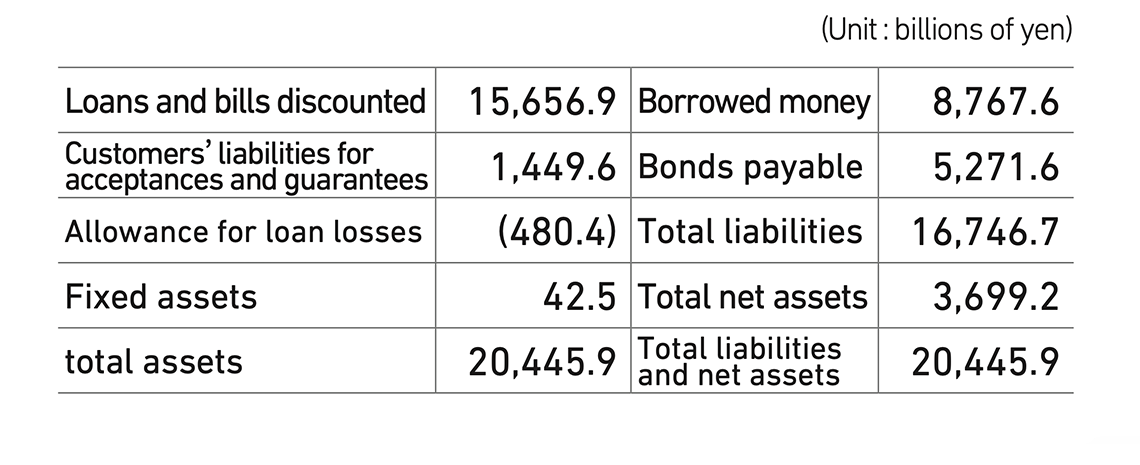
Of JBIC’s total assets of ¥20,445.9 billion, around three-quarters, ¥15,656.9 billion, are accounted for by loans and bills discounted, making long-term loans the core of its asset portfolio. Customers’ liabilities for acceptances and guarantees related to JBIC’s guarantee operations amounted to ¥1,449.6 billion. Total net assets increased by ¥453.3 billion year on year to ¥3,699.2 billion, due to an increase in paid-in capital from the Government of Japan as well as net income recorded for the year, further strengthening JBIC’s financial foundation.
●FY2025 Consolidated Balance Sheet
Financial Strategy
Addressing key challenges such as decarbonization and economic security requires continued support for large-scale, long-term projects of high policy significance. Underpinning such support is financial management that enables flexible and sustainable risk-taking. Under the Fifth Medium-Term Business Plan, JBIC is implementing a financial strategy to address diverse policy needs, including initiatives under the Japan-U.S. Strategic Investment Initiative. Built on the strengthening of its financial foundation, the strategy rests on three pillars: enhancing funding operations, providing local-currency financing tailored to project needs, and strengthening market risk management.
Ensuring a Strong Financial Foundation
As a policy-based financial institution, JBIC exercises its risk-taking function by making full use of a wide range of financial tools, primarily in foreign currencies, in order to respond to global challenges and to a wide range of financing needs in Japan and the international community. In the process, JBIC has actively implemented risk control and risk sharing by collaborating with host country governments and cooperating with other public institutions and international organizations. As a result, JBIC has established and maintained an autonomous profit structure, and has consistently been profitable since its establishment. JBIC has returned a portion of its profits to the national treasury while working to increase its own capital.
In FY2025, net assets increased as a result of an increase in paid-in capital from the Government of Japan as well as net income recorded for the year, further strengthening JBIC’s financial foundation. Underpinned by this financial foundation, JBIC is able to continue to supply risk capital as an agent of value creation even during periods of significant market volatility.
At the same time, because international and market conditions significantly impact its financial balance, JBIC must accurately ascertain and analyze the impact of risks related to climate change and geopolitics on its financial foundation, while ensuring transparent disclosure. From this perspective, in light of developments in international disclosure standards such as ISSB and SSBJ, JBIC is promoting greater sophistication in both financial management and disclosure.
JBIC will continue to maintain and strengthen a robust financial foundation that enables it to sustainably perform its role as a policy-based financial institution by securing stable underlying profits and strengthening its capital base.
Agile and Stable Fund Procurement
As a majority of JBIC’s assets are foreign currency-denominated loans, principally in U.S. dollars, JBIC regards ensuring stable foreign currency liquidity as a key issue in financial management.
In FY2025, despite encountering increasing instability in the financial markets, JBIC appropriately adapted to fluctuations in the foreign currency procurement environment. JBIC issued medium- and long-term U.S. dollar-denominated bonds and green bonds, while also utilizing currency swaps and other instruments. Through these initiatives, we achieved agile and stable foreign-currency funding while containing funding costs and extending and diversifying the maturity profile of our debt.
Moreover, based on its strong relationship with the Government of Japan, JBIC maintains regular dialogue with investors, financial institutions, and other market participants around the world. Simultaneously, in addition to financial soundness, JBIC is pursuing initiatives to improve the transparency of financial management, including its risk-taking approach. In this way, JBIC works to deepen its relationships with key stakeholders and maintain and enhance market confidence.
In FY2026, taking into account the growing uncertainty in international financial markets, JBIC will continue to execute foreign-currency funding that balances financial soundness with operational agility. This will be achieved through flexible bond issuance tailored to market conditions, as well as the maintenance and expansion of our investor base.
In addition, to contribute to the realization of a sustainable society through climate change-related financing, JBIC will continue to issue green bonds. Furthermore, by enhancing transparency, including through improved reporting, it will pursue a balance between financial operations and environmental value creation.
Providing Support in Locally Denominated Currencies
In order to respond to diverse funding needs in various countries and regions, including support in infrastructure sectors, JBIC is promoting local-currency-denominated financing. Such financing helps reduce borrowers’ foreign exchange risk and contributes to the stable operation of projects by better aligning project revenues with the currency of funding. To make such support possible, close collaboration with local financial institutions and financial authorities is essential. Based on the relationships hitherto built up, JBIC has established a system capable of handling the currencies of countries and regions across Asia, Latin America, and other parts of the world. JBIC will continue to further expand local-currency-denominated financing, taking into account market conditions and project needs in each country and region.
Market Risk Management
As JBIC holds foreign-currency-denominated assets and liabilities, it must appropriately manage the market risks arising from fluctuations in interest rates and foreign exchange rates. JBIC, in principle, fully hedges the foreign exchange risk associated with its foreign-currency lending through currency swaps, and appropriately manages interest rate risk by managing its funding on a floating-rate basis through the use of interest rate swaps. Going forward, JBIC will continue to ensure financial soundness through market risk management using currency and interest rate swaps. At the same time, it will work to maintain and strengthen the financial foundation needed to steadily fulfill the risk-taking function required in areas of high policy significance, including economic security.
Funding Sources
In order for JBIC to sustainably exercise risk-taking functions and provide stable support for long-term foreign currency-denominated projects, it is important to steadily secure the necessary funds. In doing so, JBIC must take into account the actual progress of projects and their funding needs, and raise funds in a manner that does not exert an excessive impact on markets.
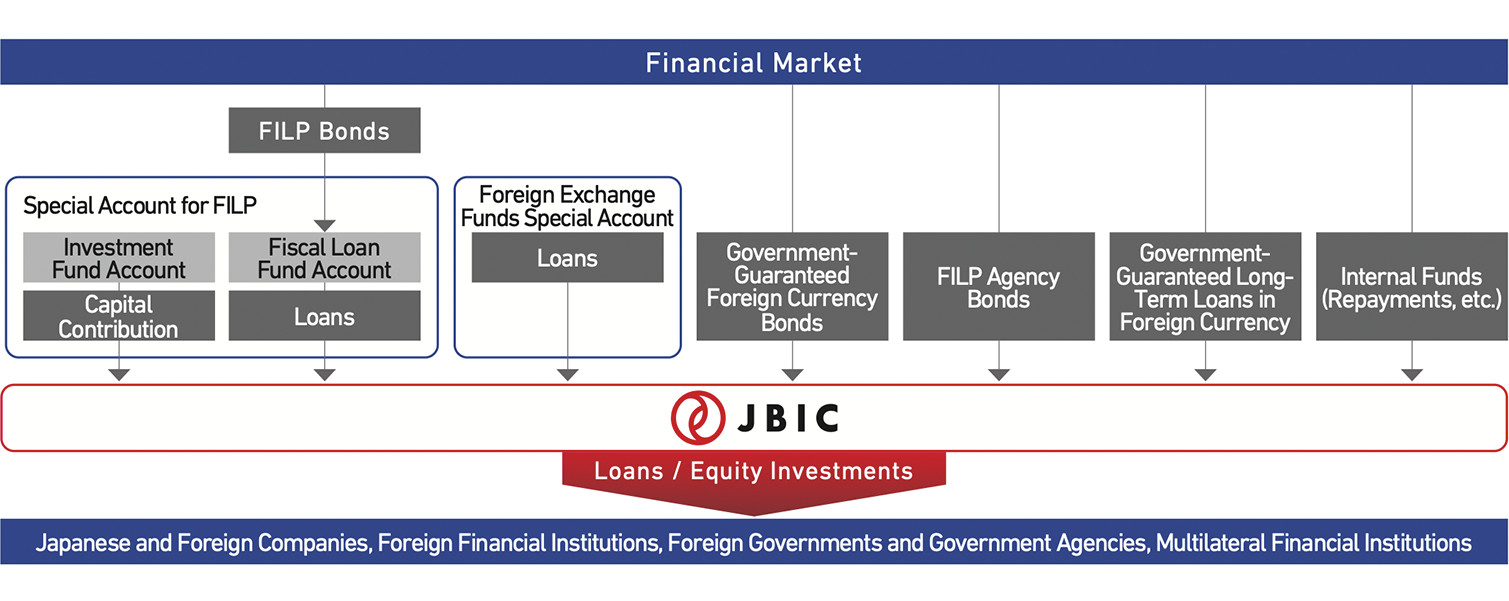
JBIC leverages a diverse range of funding instruments, including government-guaranteed foreign currency bonds and fiscal investment and loan program (FILP) agency bonds, which are non-guaranteed domestic bonds, while maintaining close and careful dialogue with market participants to preserve and expand its investor base. Building on market confidence, JBIC conducts disciplined funding from a medium- to long-term perspective.
●Funding Sources
Government-Guaranteed Foreign Currency Bonds
Government-guaranteed foreign currency bonds play a central role in JBIC’s funding operations. Outstanding government-guaranteed foreign currency bonds at the end of FY2025 amounted to ¥5,269.6 billion at face value, accounting for 37.46% of the total outstanding borrowings and bonds. Funds raised through government-guaranteed foreign currency bonds are used primarily to finance JBIC’s foreign-currency-denominated loans. In addition, government-guaranteed foreign currency bonds carry the same credit ratings as the Government of Japan and are assigned a zero risk weight for the purpose of calculating the capital adequacy ratios of deposit-taking financial institutions. Their high credit quality and favorable regulatory treatment are therefore highly regarded in the international capital markets.
Furthermore, in October 2021, with the aim of contributing to the realization of a decarbonized society through green finance, JBIC developed the JBIC Green Bond Framework, which is aligned with the Green Bond Principles 2021, published by the International Capital Market Association. In January 2022, JBIC issued its first green bond. Since then, JBIC has continued to issue green bonds denominated in U.S. dollars and euros, while working to deepen its dialogue with investors. The proceeds are allocated to decarbonization-related projects with high GHG emission reduction effects, such as renewable energy and green mobility. Going forward, through continuous issuance and transparent reporting, JBIC will contribute to the realization of a sustainable society while balancing environmental value creation and dialogue with the market.
FILP Agency Bonds
In compliance with the government policy to reform the Fiscal Investment and Loan Program system, JBIC has issued FILP Agency Bonds, in Japan’s domestic capital markets as a means of raising market-based funds on the strength of its own creditworthiness. JBIC makes flexible use of FILP Agency Bonds as needed to diversify its funding sources.
In May 2024, JBIC issued its first green bond as a FILP Agency Bonds and has been strengthening access to a diverse investor base. In the FY2026 budget, JBIC plans to issue such bonds for a maximum amount of ¥20 billion.
JBIC’s outstanding FILP Agency Bonds carry the same credit ratings as the Government of Japan from rating agencies and are assigned a 10% risk weight for the purpose of calculating the capital adequacy ratios of deposit-taking financial institutions. Accordingly, they are regarded in the market as highly creditworthy investment instruments.
Rating & Investment Information, Inc. (R&I)・・・AA+
Japan Credit Rating Agency, Ltd. (JCR)・・・AAA
Moody’s Japan K.K.・・・A1
S&P Global Ratings Japan Inc.・・・A+
(As of June 26, 2026)