JBIC STORY
In 2022, JBIC established the Sustainability Management Department to support efforts to integrate sustainability into management and business operations. MIZUNO Kyoka and NOMIYAMA Hyo, two young JBIC staff members working on the front lines, speak about the rewards and challenges of their work.
(left)
Division 1, Sustainability Management Department
Corporate Planning Group, JBIC
MIZUNO Kyoka
Started working for the central government in 2019, and after moving to a consulting firm, joined JBIC as a mid-career hire in 2023. At Division 1 of the Sustainability Management Department, she is engaged in planning and research in the field of climate change, as well as the calculation of GHG emissions and emission reductions. Graduated from Rikkyo University, the College of Business.
(right)
Division 2, Sustainability Management Department
Corporate Planning Group, JBIC
NOMIYAMA Hyo
Joined the bank in 2024. At Division 2 of the Sustainability Management Department, he is responsible for gathering, researching, and disseminating domestic and international information on sustainability initiatives, including the circular economy and impact-related fields. Completed the master's program at Hokkaido University, Graduate School of Engineering, Division of Environmental Engineering.
Providing financing with a long-term perspective
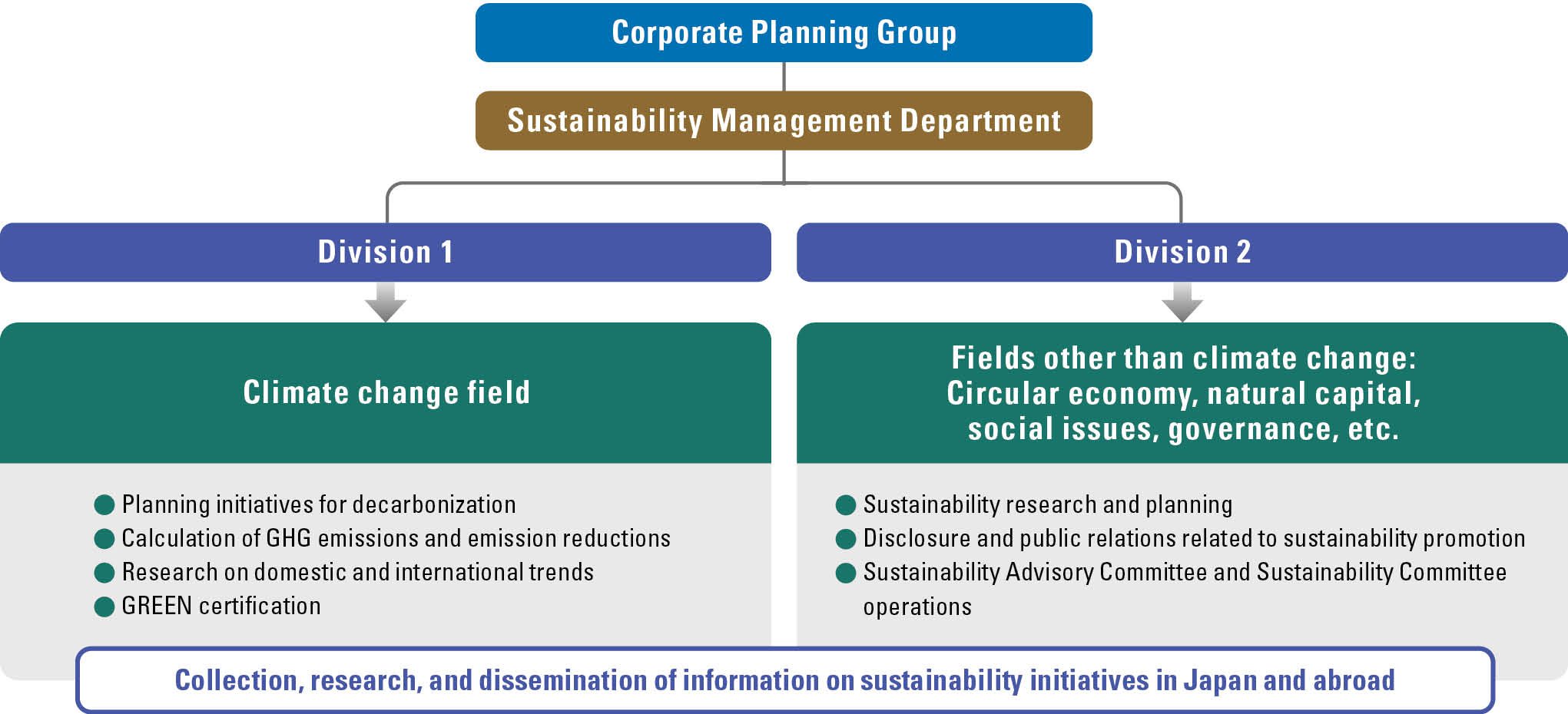
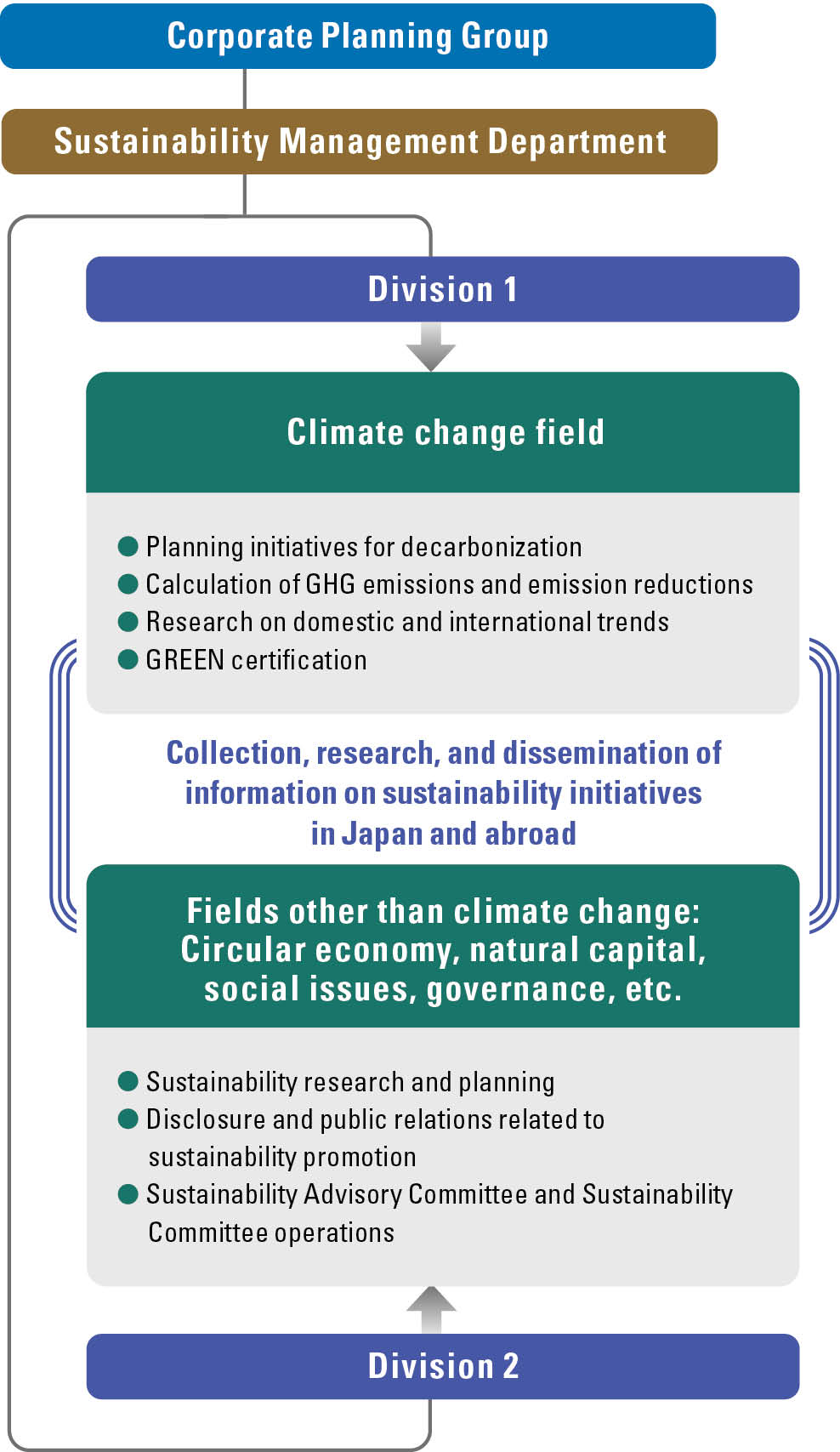
JBIC has been providing support to businesses that contribute to global environmental conservation, and in 2022 it established the Sustainability Management Department, comprising two divisions, to further strengthen such initiatives. Division 1 is primarily responsible for the field of climate change, while Division 2 handles other fields such as the circular economy, natural capital, and human rights. Both divisions are tasked with gathering information and conducting research, then actively sharing that information with the bank's management and business divisions to foster a culture of sustainability throughout the organization.
"Sustainability is in a transitional phase, evolving beyond a traditional corporate social responsibility (CSR) approach toward integration into business as a core strategy," says MIZUNO Kyoka of Division 1. "Since value creation takes time, I believe this is an area well-suited to policy-based financial institutions that can provide financing from a medium- to long-term perspective."
MIZUNO's work is in the field of climate change, where she is involved in planning initiatives for decarbonization, calculating greenhouse gas (GHG) emission reductions, and researching domestic and international trends. One important responsibility is assessing whether projects meet the program's eligibility criteria for Global action for Reconciling Economic growth and ENvironmental preservation (GREEN), confirming that they contribute to global environmental conservation.
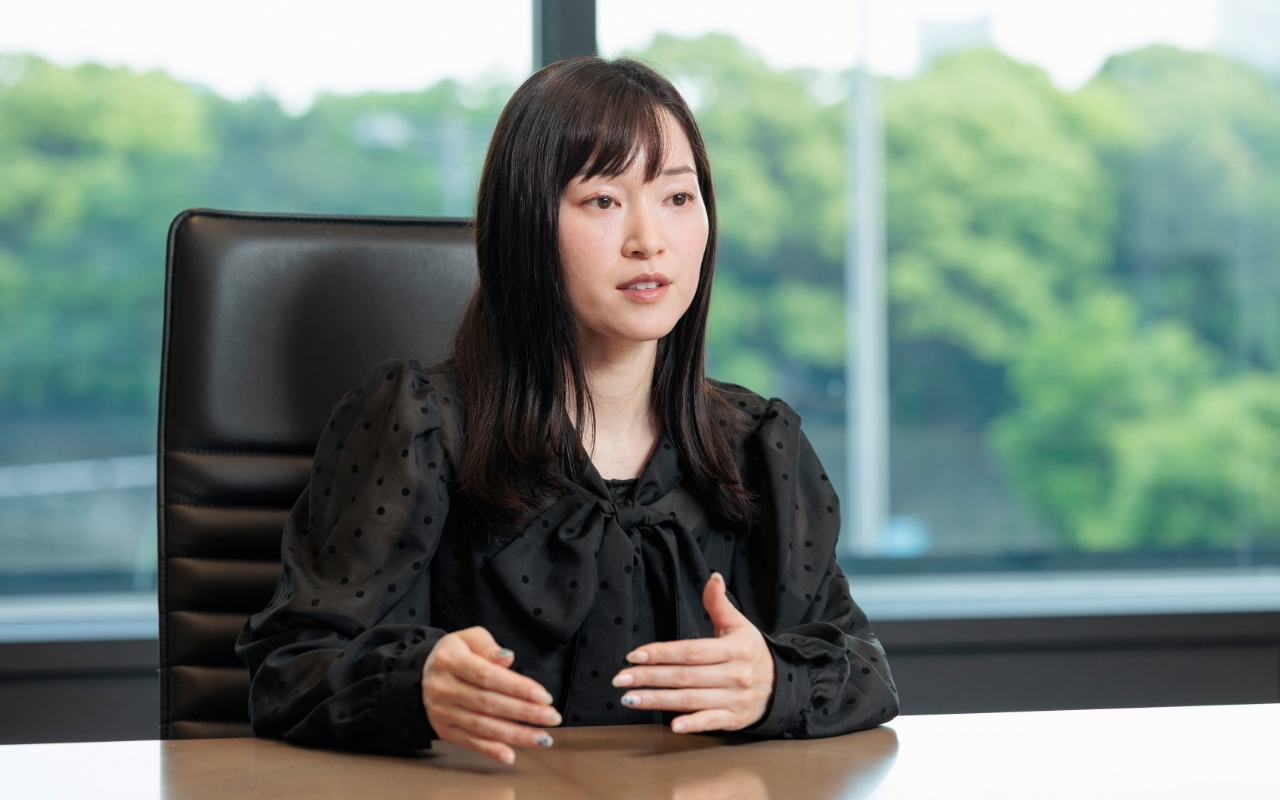
MIZUNO says that although there is no right answer to responding to climate change, she strives to always collect information and engage in discussions in order to gain a clearer picture of the situation.
According to NOMIYAMA Hyo of Division 2, who handles sustainability-related planning and studies in fields other than climate change, the circular economy is a new framework that aims for growth while also efficiently circulating resources. "The circular economy has now reached at the stage where it can expand as a business. Because of the high costs and risks, it is currently an area that is difficult for the private sector alone to advance, but private capital can be attracted if JBIC takes on these risks," he says of the significance of JBIC's involvement.
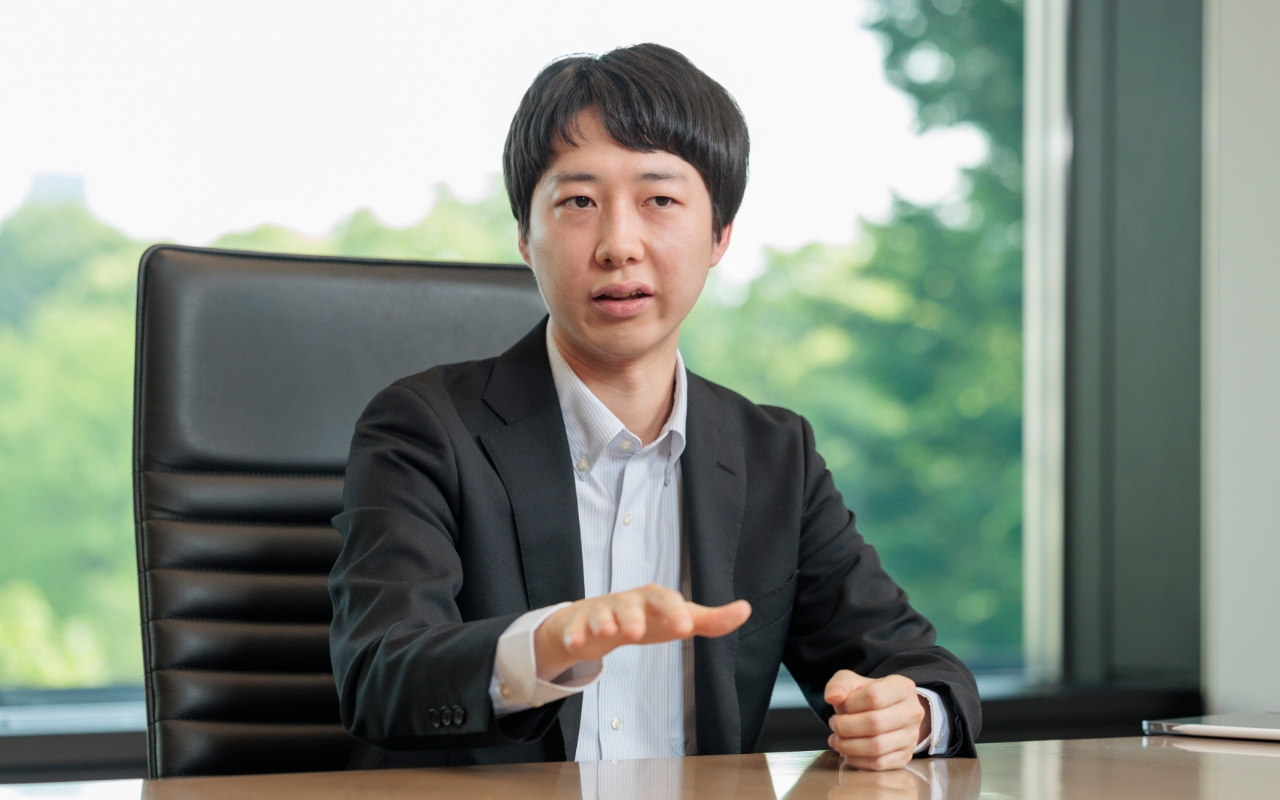
NOMIYAMA, who majored in environmental engineering, says his current work exploring the intersection of sustainability and business aligns with his background, making it very fulfilling.
Although there is growing momentum to integrate sustainability into business, a key challenge is that there is no one-size-fits-all solution.
"Approaches to climate change vary across countries and regions, and there is no single right answer. Even well-founded decisions may lead to different outcomes as assumptions change in an increasingly uncertain world. In some cases, it may take a decade or more before we know whether a decision was truly the best one," says MIZUNO.
That is precisely why MIZUNO actively follows both domestic and international trends to gain as clear a picture of the situation as possible.
NOMIYAMA is exploring how to balance sustainability and business: "Environmental conservation is important, of course, but it won't be sustainable unless it becomes a system that works as a business. It becomes crucial to figure out how to transform environmental costs into business value and how to strike a balance with profitability."
On a business trip to the United States this past January, NOMIYAMA visited international financial institutions, including the World Bank, and conducted interviews on their circular economy initiatives. Looking back, he was impressed to see how, even amid opposition to sustainability, they were generating momentum that goes beyond environmental themes by connecting the circular economy with economic security considerations, such as the recycling of critical minerals.
Actively sharing information to spread the initiative across the bank
Both MIZUNO and NOMIYAMA make a conscious effort to keep colleagues across the bank informed of the insights they gain through their work. These days, other departments increasingly seek out their advice, which they feel is a sign that sustainability is steadily gaining traction across the organization.
MIZUNO, who joined the department as a mid-career hire in 2023, says, "We started this initiative with no established roadmap, learning through trial and error along the way. It has now reached the operational phase and is firmly on track. Being involved from the outset has been incredibly rewarding."
While climate change remains at the core of her work, MIZUNO says she would like to gain experience in a wide range of fields, including the structuring of infrastructure and resource-related projects, as well as credit assessment and risk management. "I would like to develop the ability to broaden my perspective and arrive at the best possible solutions," she says.
NOMIYAMA, who majored in environmental engineering in graduate school, decided to join JBIC because he wanted to be "directly involved in balancing environmental conservation and business." Just as he wished, he was assigned to the Sustainability Management Department, where he is now in his third year.
"It is important to accurately interpret the new themes that continue to emerge in the realm of sustainability and share this information in an easy-to-understand manner. This consequently leads to their smooth integration into business," he says, adding that JBIC's strength is its ability to serve as a bridge for integrating sustainability into business by acting as an intermediary between Japan and overseas, and between the private and public sectors.
Feeling that he still lacks sufficient business acumen to better reconcile sustainability and business, NOMIYAMA hopes to gain experience in areas such as sales and finance.
"By learning more about corporate business strategy and finance, I hope to be able to consider approaches to environmental conservation from a business perspective as well," he says.
The two will continue their efforts to advance the implementation of sustainability, an area where a policy-based financial institution is perfectly positioned to contribute.

Spreading new concepts such as the circular economy across the bank is also an important part of the Sustainability Management Department's work.
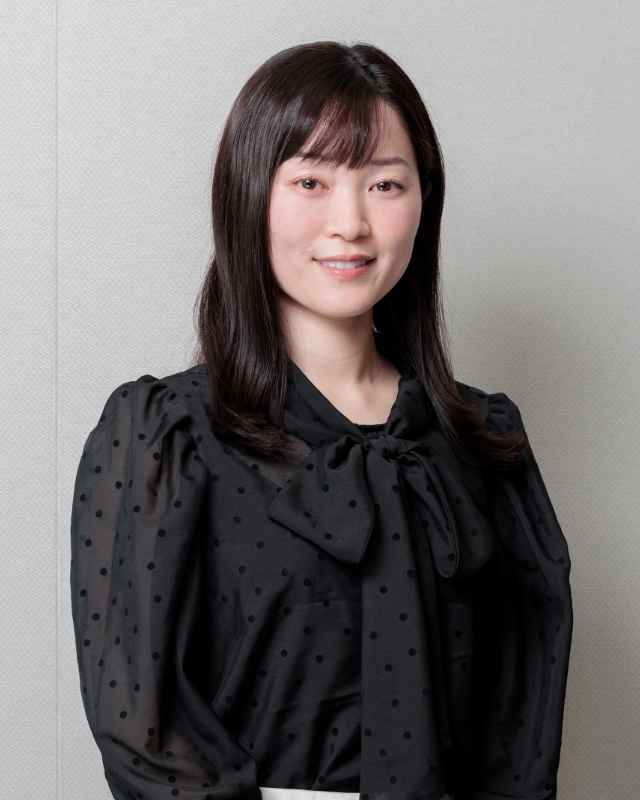
MIZUNO Kyoka, Division 1, Sustainability Management Department, Corporate Planning Group, JBIC
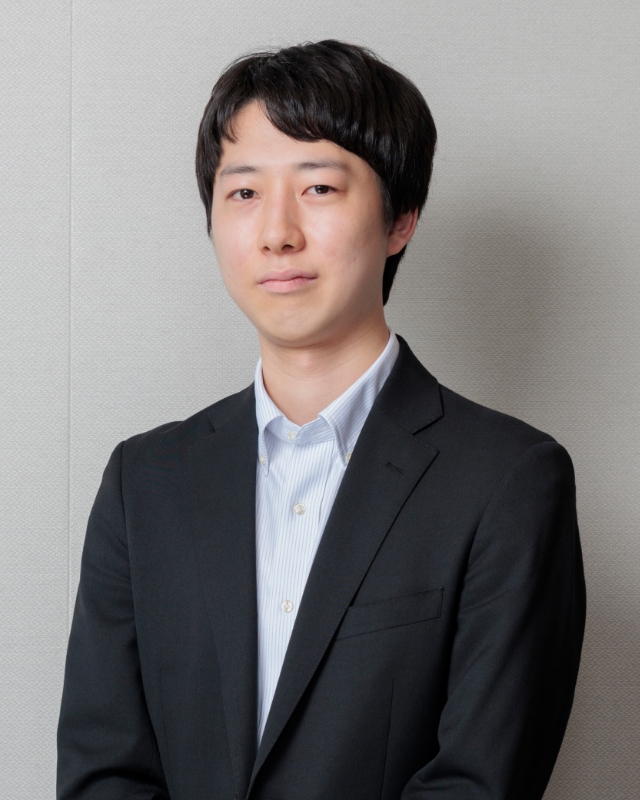
NOMIYAMA Hyo, Division 2, Sustainability Management Department, Corporate Planning Group, JBIC


In June 2022, JBIC established the Sustainability Advisory Committee, Sustainability Committee, and Sustainability Management Department as a part of its efforts toward "strengthening its sustainability governance and management systems," as set out in the ESG Policy. The Sustainability Management Department, which comes under the Corporate Planning Group, consolidates expertise and functions related to sustainability and drives JBIC's initiatives for achieving sustainability.