



Feature ArticleBIOFUELS FOR ENERGY SECURITY
Against the backdrop of increasing international instability, energy policy is no longer just an environmental issue. As a realistic option that can use existing infrastructure, biofuels are once again in the limelight. With domestic adoption still sluggish, there are opportunities for Japan to become deeply involved in biofuels from their production stage. AMANO Tatsushi, Global Head of JBIC’s Energy and Natural Resources Finance Group, explains the potential of a growth strategy that avoids dependence on any single energy source.




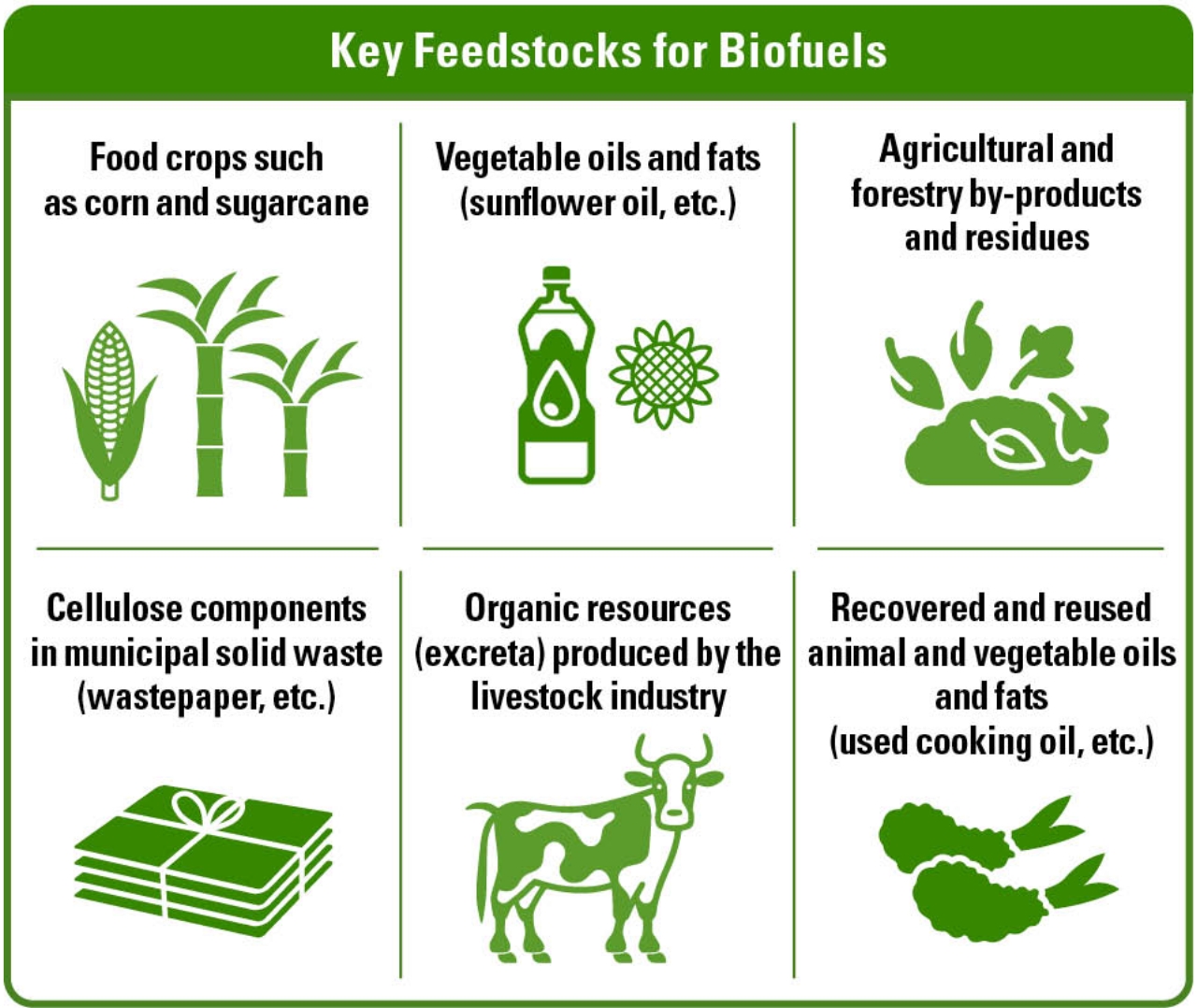
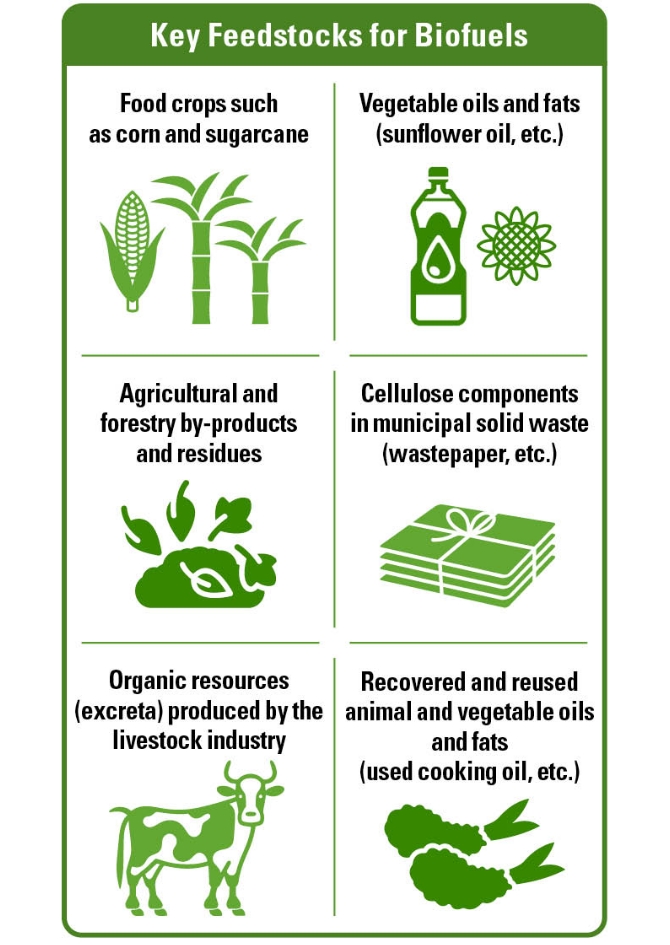
Biofuels are fuels produced from biomass such as plants and used cooking oil. Although they emit CO₂ when burned, the plants used as feedstock absorb CO₂ during their growth, resulting in lower life-cycle carbon than fossil fuels. Biofuels are attracting global interest from the perspectives of both decarbonization and energy security. In Brazil, sugarcane-based ethanol is widely used as a gasoline blend, and in Europe and the United States, advancements are being made in the adoption of sustainable aviation fuel (SAF).
Brazil and Indonesia are front-runners as biofuels win renewed appreciation
At an energy conference in Singapore three years ago, everyone was saying the same thing: the dawn of renewables and hydrogen had arrived.
“But that view has changed now,” says AMANO, JBIC’s Senior Executive Managing Officer.
Behind this comment is the reality that hydrogen production and transportation costs have not fallen to the levels expected. There is a growing awareness that although decarbonization efforts are underway, fossil fuels will remain an essential part of the energy mix for the time being.


Senior Executive Managing Officer, Global Head of the Energy and Natural Resources Finance Group, JBIC, AMANO Tatsushi
Moreover, in recent years, the Russia-Ukraine conflict and growing instability in the Middle East have again shown the vulnerability of energy supply chains. Soaring resource prices and supply disruptions also have major impacts on countries’ economies, making energy policy an issue that not only has environmental consequences but is also one directly linked to national competitiveness and security.
“Because of this, in addition to promoting decarbonization, the importance of reducing dependence on specific regions and diversifying energy supply sources for energy security has also been growing in recent years,” emphasizes AMANO.
Against this backdrop, there is renewed interest in biofuels—fuels made from biomass such as plants and used cooking oil. Their defining feature is that they can help reduce CO₂ emissions while using existing infrastructure. Biofuels actually have a history of about 130 years. The first fuel used in the real-world implementation of the diesel engine—invented as a more economical alternative to the steam engine—was peanut oil. Rather than a new technology, biofuels were an energy source that predated fossil fuel dominance.
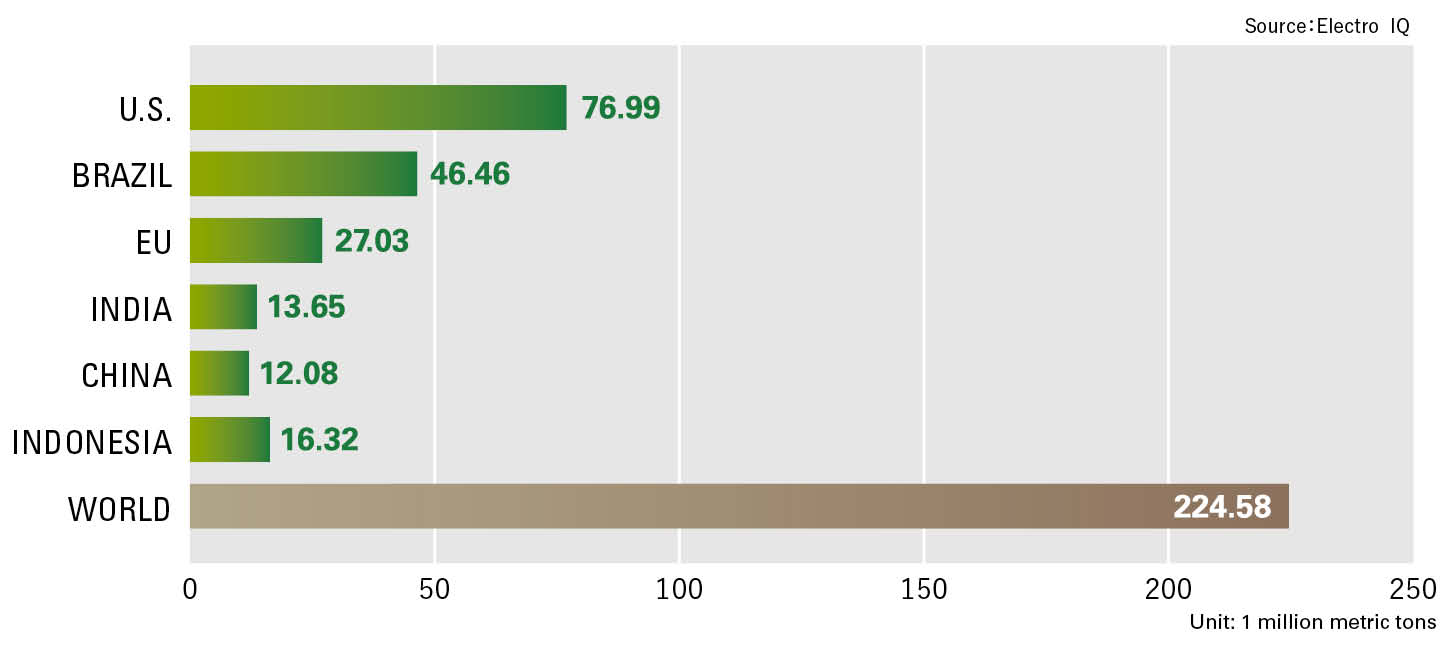
Today, countries with abundant feedstocks are moving ahead with biofuel adoption. In Brazil, bioethanol derived from crops such as sugarcane or corn is used widely: gasoline for automobiles is required to contain 22 to 35 percent bioethanol. There are even vehicles that can run on 100 percent bioethanol. Meanwhile, a policy for palm oil-based biofuel is being actively promoted in Indonesia.
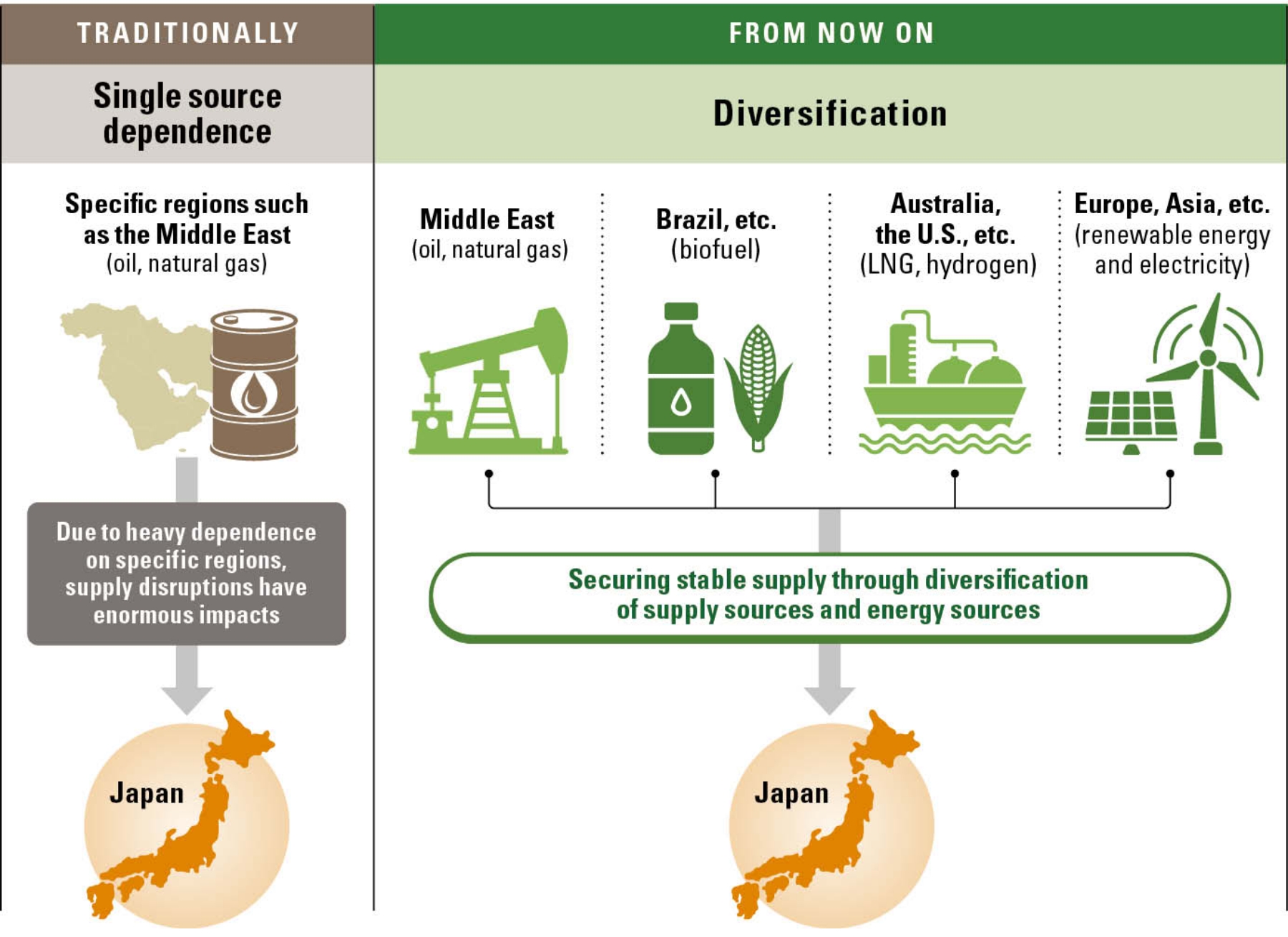
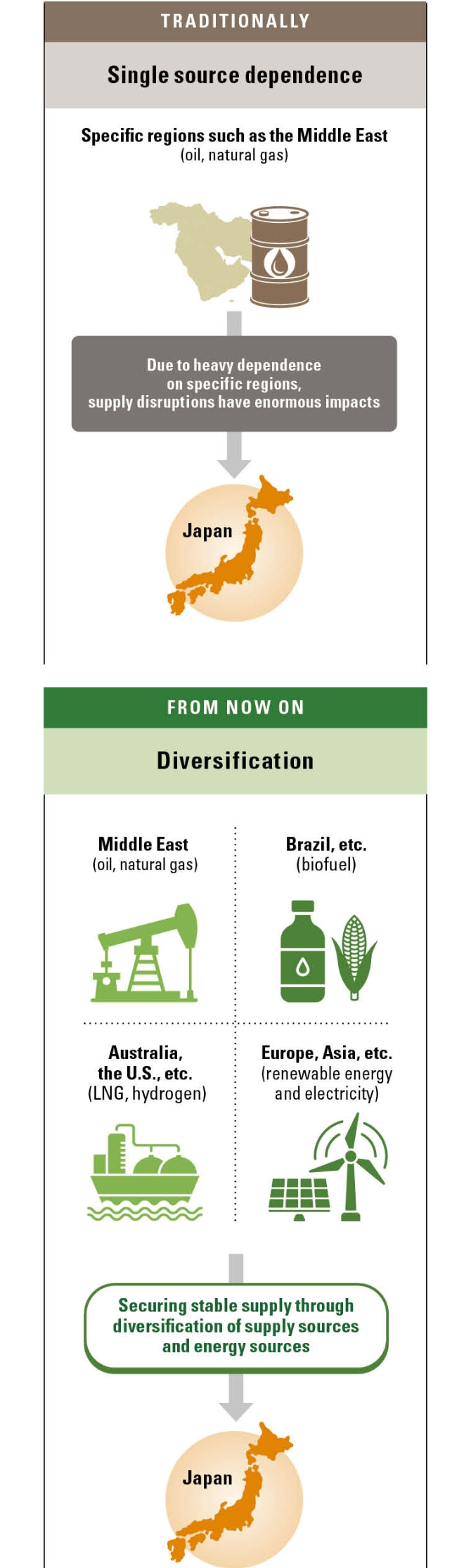
A major strength of biofuels is that they can be adopted without significant change to existing logistics networks or gas station facilities, notes AMANO. As a result, transition costs can be contained.
Blending a certain percentage of biofuel into gasoline reduces dependence on imported crude oil accordingly: a 10 percent biofuel blend equals 10 percent less imported crude.
“Countries with diversified power sources can maintain their strength regardless of what happens in the world. When it comes to energy security, I believe the most important thing is not to rely on a specific country or technology.”
From just importing fuel to involvement in production JBIC coordinates with local partners
Although biofuels are being reevaluated worldwide, their use in Japan remains limited due mainly to insufficient domestic sources of feedstock. Unlike countries such as Brazil and Indonesia, which can mass produce feedstocks like sugarcane and palm oil, Japan has to rely on overseas sources, pushing up costs, including shipping. As a result, biofuel production remains limited in Japan.
There was a period after the oil crises of the 1970s when Japan, too, attempted to introduce biofuels, but their high cost meant that the development of energy-saving technologies and high-efficiency engines was prioritized. In addition, based on the premise that oil imports would remain stable, technological innovations were focused on fuel efficiency, and investment in biofuels never gained ground.
With the global biofuel market projected to expand, AMANO maintains the view that Japanese companies should not merely import biofuels, but should be deeply involved from the production phase. “Partnerships with feedstock-producing countries are extremely important. Simply purchasing fuel will only lead to new dependencies. It is indispensable for Japanese companies to get involved in the production process.”

“Rather than depending on any particular country or region for energy, building diversified supply chains will strengthen Japan’s energy security,” says Amano.
While engaging in the crucial issue of national energy policy, JBIC serves as a coordinator for Japanese companies to establish good relationships drawing on the trust it has built with governments and local companies over the years.
Recent developments include a business roundtable held with PT Pertamina, Indonesia’s state-owned oil company (see p.8–9). The concept is to establish production in feedstock-rich countries like Indonesia and Brazil, and after first building a local-production-for-local-consumption model, look toward expanding supplies to Japan. AMANO says that in addition to manufacturing, there is also room for Japanese companies to participate in areas such as logistics and quality control. “Transport costs are still high, so in-country production is the first step. If costs subsequently drop, expansion to Japan becomes possible.”
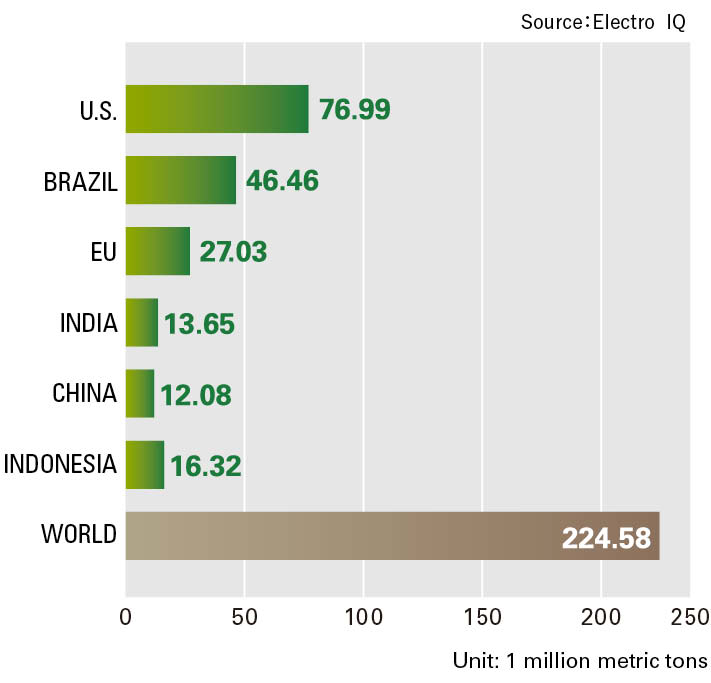
(by country/region)
Potential for biofuel utilization that draws on Japan’s strengths
AMANO believes that Japan can leverage its strengths in biofuel applications across a range of sectors.
In the maritime and aviation sectors, where decarbonization through electrification is difficult, a shift in fuels is indispensable. Japan’s shipping industry is highly competitive globally, and can make its presence felt in areas such as introducing specialized biofuel vessels.
The Japanese automotive industry offers a diversity of options: internal combustion engines, hybrids, hydrogen vehicles, and electric vehicles (EVs), with “strengths in all kinds of powertrain technologies,” says AMANO. Although the global shift to EVs is accelerating, they are not necessarily the optimum solution for every region or application, and so internal combustion engines will continue playing a role. Using biofuels with existing engine technologies will contribute greatly to decarbonization.
In the steel industry, research is also underway on using high-density charcoal as an alternative to coal-derived coke. Even in blast furnace steelmaking—also difficult to decarbonize—this is seen as a practical solution for reducing emissions while utilizing existing facilities. Technologies using biomass are also drawing attention from the perspective of maintaining industrial competitiveness.
The significance of biofuels in energy diversification
Biofuels have been viewed as “a bridge to a hydrogen economy, and a technology that merely supports the transition phase.” However, AMANO believes it is “highly likely that biofuels will remain one of a diverse range of energy sources.” In addition to the difficulty of spreading the use of hydrogen, the global shift toward prioritizing energy security means that dependence on any single energy source is seen as a risk in itself.
“In conversations with energy company executives from Japan and abroad, I now hear them say: ‘Even if Iran and the United States were to agree today on an immediate ceasefire, the energy landscape will change. We will never return to the days when more than 80 percent of our oil was purchased from the Middle East.’ It is probably inevitable that the energy business will become more diversified.”
These circumstances are leading to projections that the biofuel market will expand, and as the energy landscape undergoes sweeping changes, opportunities are also growing for Japanese companies to participate in building new supply chains. Japanese companies possess strengths across many fields, not limited to biofuel production and distribution. If they can collaborate and cultivate business with overseas partners, this could also bolster Japan’s industrial competitiveness.
That also makes it important to establish long-term feedstock procurement contracts and financial support mechanisms. Because this is an industry with large uncertainties surrounding raw materials, such as adverse weather conditions and fluctuating crop prices, a policy-based financial institution like JBIC has a crucial role to play.
In an age that demands a balance between decarbonization and energy security, it is crucial to diversify energy sources rather than rely on a single solution. EVs, hydrogen, renewable energy, and biofuels—combining these technologies and drawing on multiple energy sources seems to be the most realistic path forward.


Senior Executive Managing Officer
Global Head of the Energy and Natural Resources Finance Group, JBIC
AMANO Tatsushi
Joined JBIC in 1995. As Global Head of the Energy and Natural Resources Finance Group since July 2023, responsible for the analysis of trends and formulation of strategies in the fields of global energy and resources. From 2019 to 2023, as Director General of the Strategic Research Department, charged with the overseas expansion of Japanese companies and geopolitical analysis. Graduated from the University of Tokyo, Faculty of Law, and University of Pennsylvania Carey Law School. A New York State registered attorney.

