



Feature ArticleBIOFUELS FOR ENERGY SECURITY
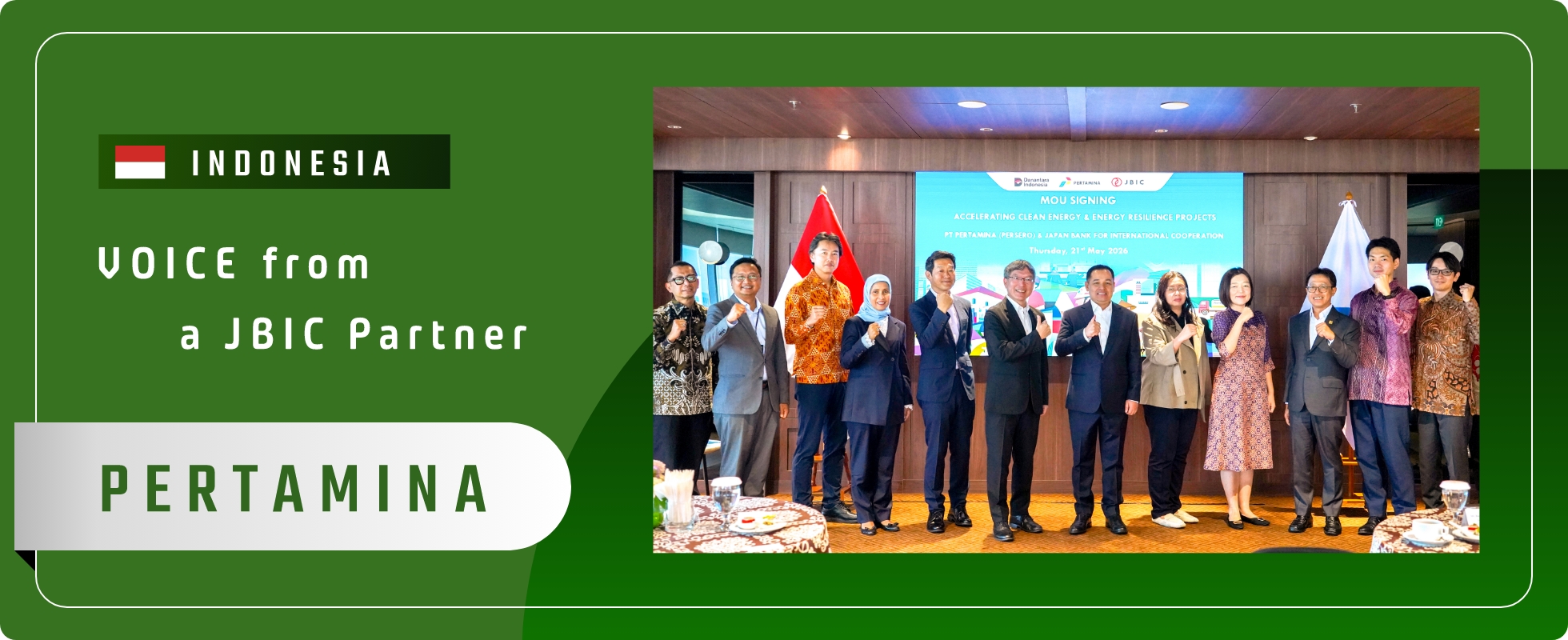
Participants at a workshop hosted by Pertamina and JBIC on May 21. (Photo: Courtesy of the Pertamina Energia Team)
As Indonesia works toward its goal of net zero by 2060, the state-owned energy company Pertamina is pursuing what it calls a dual growth strategy by maintaining its legacy oil and gas business as it scales up low-carbon alternatives. At the heart of the emission reduction efforts are biofuels, a solution it is implementing amid deepening cooperation with JBIC and Japanese companies.
"Pertamina's strategic priorities are centered on supporting Indonesia's energy security, while at the same time advancing the country's long-term decarbonization agenda," says Juferson Victor Mangempis, Pertamina's VP of Investor Relations. "Growth in the legacy business supports our cash flow and supply reliability, while low-carbon expansion positions Pertamina for long-term sustainability."
Multiple objectives
Mangempis emphasizes that biofuels serve two of Indonesia's objectives simultaneously: cutting emissions and strengthening energy security.
"Indonesia is blessed with a lot of plantations, so we want to leverage our domestic resources," he says. As a net fuel importer, Indonesia sees domestic biofuel production as a way to reduce its dependence on external sources and improve its energy self-sufficiency through the 2030s.
Government policy is accelerating adoption. July 1 saw Indonesia implement B50 (diesel blended with 50 percent biofuel, up from the previous 40 percent regulation) alongside a new ministerial decree aiming to secure feedstock supply as part of efforts to cut diesel imports.
A vanguard of the biofuel shift is a pilot project at Pertamina's Cilacap refinery producing sustainable aviation fuel (SAF). The fuel has already powered test flights by flag carrier Garuda Indonesia from Jakarta to Solo, and sister company Pelita Air from the capital to Bali. The company is now seeking partners to scale up capacity, with further early-stage projects underway at its Dumai refinery.
Finding the right partner
The major hurdle for SAF is cost, acknowledges Mangempis: "The economics of scale are not there yet. Up until now, we haven't seen the market absorb the price of SAF."
Airlines already squeezed by fuel costs balk at the gap between SAF and conventional jet fuel. Feedstock cost reductions, processing technology improvements and growing demand are set to bring prices down.
"The biggest challenge is finding the right partner who can help us not only with technology but also with financial schemes to reduce the cost of investment and capital," he says, adding that a stable, long-term regulatory framework is crucial in convincing investors to commit.
Geography adds another challenge. Indonesia's archipelago of thousands of islands makes distribution to remote areas costly.
"It's very different from China or Europe," notes Mangempis, who sees shipping and connectivity infrastructure as areas ripe for cooperation.
Keeping in the green zone
Balancing energy security with decarbonization calls for discipline and patience, says Mangempis: "We are not trying to run as far as we can. Like a runner wearing a smartwatch, we keep our pace in the green zone. We don't want to be in a rush, but we don't want to be too late either."
That measured approach extends to the renewed and broadened MOU with JBIC, which now reaches beyond biofuels into areas including geothermal, hydrogen, carbon capture and storage (CCS), and supply-chain resilience. Geothermal is a particular prize: despite 40 years of development, capacity has been held back by factors including a single buyer, the state electricity company, and high upfront costs in remote areas. Nevertheless, Pertamina is exploring the concept of green data centers powered by geothermal.
Building on the relationship
A workshop in May brought fourteen Japanese companies together with Pertamina and JBIC. Mangempis was struck by the depth of technical expertise on display and saw potential in the Japanese firms' advanced knowhow in feedstock pretreatment, processing technology and process control for ensuring the efficiency and quality of biofuel production.
With the USD50 million co-financing arranged in 2022, including USD 30 million from JBIC, now supporting its renewables push, Pertamina hopes more concrete projects will follow. Looking further ahead, Mangempis sees biofuels potentially becoming an export, including to Japan, once domestic energy security is assured.
In the meantime, Mangempis believes balance is the watchword and riffs on the runner's zone analogy: "We all love green, right?"
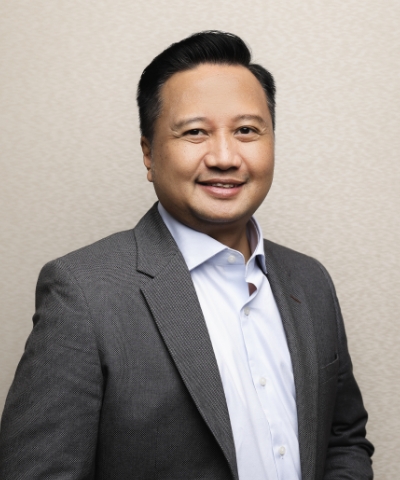

Vice President Investor Relations, Pertamina
JUFERSON VICTOR MANGEMPIS

