



Feature ArticleBIOFUELS FOR ENERGY SECURITY
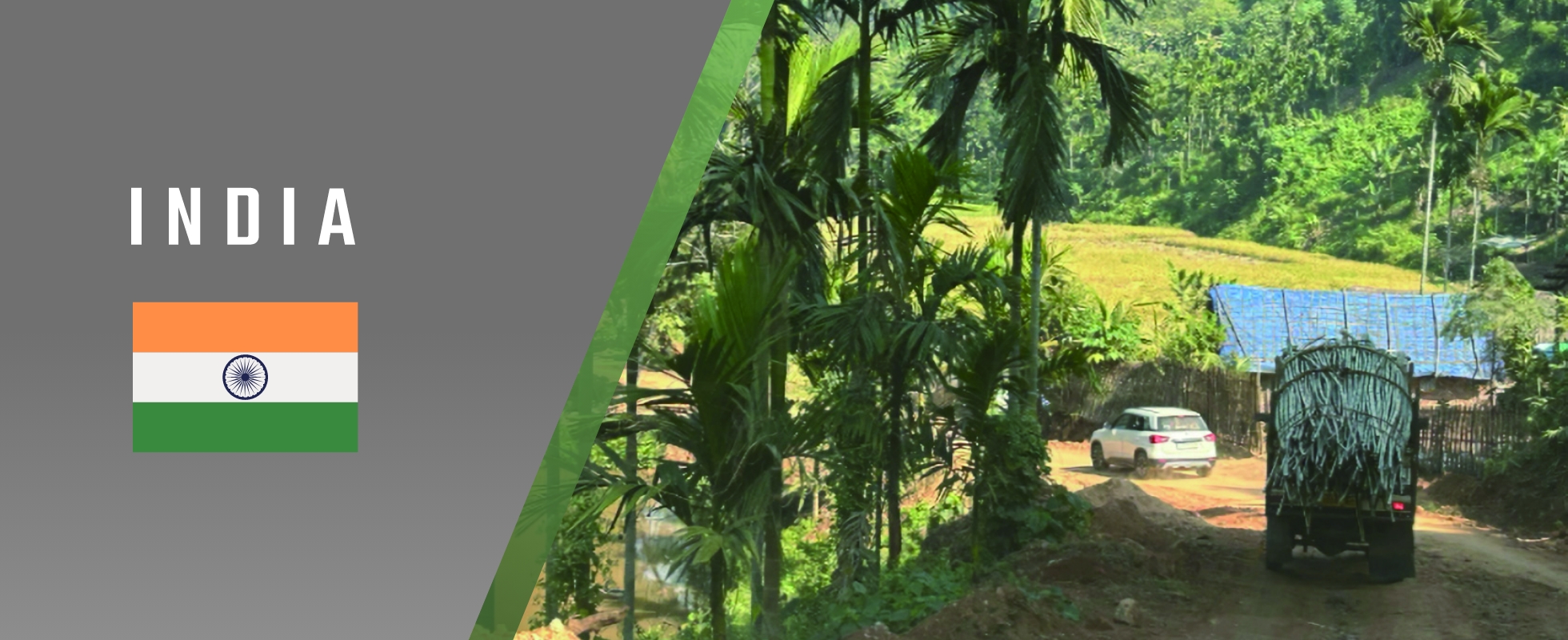
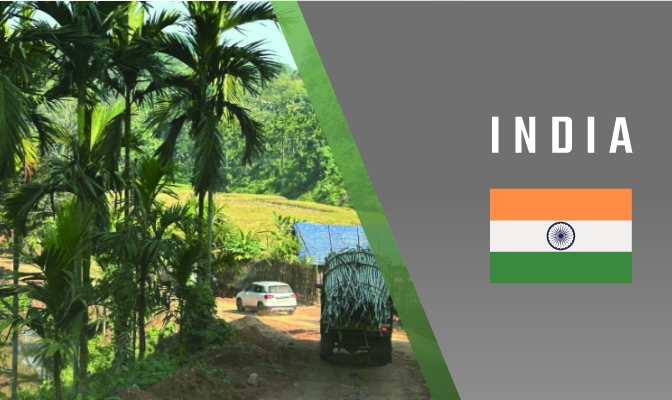
The Modi administration sees the state of Assam—with its plentiful wild bamboo—as a key region for development.


Amid rapid ongoing economic and population growth, India is aiming to break its dependence on imported fossil fuels and raise its energy self-sufficiency. To achieve net zero by 2070, the country is rapidly rolling out biofuels on a national scale and is emerging as a global ethanol powerhouse alongside the United States and Brazil. Aware of the risk of food-versus-fuel conflict when crops such as sugarcane are used for fuel, India has now begun fostering a second-generation biofuel industry using feedstock such as bamboo, agricultural crop residue, and organic waste. A distinctive sustainable green economy is taking shape.
In the northeastern Indian state of Assam, the world's first commercial production plant for bamboo-based bioethanol is currently in operation. The project is led by Assam Bio Ethanol Private Limited (ABEPL). JBIC is supporting this cutting-edge project through Power Finance Corporation Limited (PFC), a government financial institution in India, with which it signed a loan agreement of up to JPY60 billion.

Division 2, New Energy and Power Finance Department II, Infrastructure and Environment Finance Group, JBIC, WATANABE Takuya (left) & NAKAMURA Asuka (right)
Bamboo shows new possibilities as 2G bioethanol
Established in order to realize this venture, ABEPL is a globally diverse entity, notes WATANABE Takuya, who worked on the loan agreement for JBIC.
"The main sponsor is Numaligarh Refinery Limited (NRL), whose equity is held by the Assam state government and companies owned by the Indian central government, with co-investment by two companies from Finland—a power company and a company with bamboo-based ethanol production technology," says WATANABE. "The plant was built next to NRL's expansive oil refinery, with NRL being the primary purchaser of the ethanol produced by ABEPL."

Division 2, New Energy and Power Finance Department II, Infrastructure and Environment Finance Group, JBIC, WATANABE Takuya
NAKAMURA Asuka, who worked with WATANABE on this project, explains the benefits of using bamboo as feedstock: "Conventional biofuels made from feedstock such as sugarcane pose the issue of a food-versus-fuel tradeoff, but using bamboo as a second-generation biofuel does not have that problem. Furthermore, while India has strict regulations on logging to protect its forests, it allows the industrial use of fast-growing bamboo. Assam is a region with an abundant amount of wild bamboo, but since it had been used mainly for handcrafts and so on, there was a vast untapped surplus. ABEPL spotted this opportunity and took on the challenge of using bamboo as feedstock for bioethanol."
Witnessing firsthand the contributions to Assam
The JBIC team also visited the site in the lead-up to the signing of the loan agreement. To ensure a stable supply of feedstock, ABEPL forged close ties with local small-scale farmers and communities, and organized some 30 local plantations for comprehensive management of everything from the cultivation of bamboo to logistics, explains WATANABE.
"I was able to directly sense the enormous expectations and enthusiasm of the local farmers, who hold the future of the rural economy in their hands," he says.
NAKAMURA recalls: "I attended the plant's opening ceremony. I still remember being deeply impressed by the beautifully illuminated ABEPL plant, which appeared in front of us after a drive on country roads surrounded by lush nature. When I saw with my own eyes the huge production line that carries the bamboo through the various production stages, I truly realized that we will be supporting a project of such tremendous scale through our financial partnership with PFC."

Division 2, New Energy and Power Finance Department II, Infrastructure and Environment Finance Group, JBIC, NAKAMURA Asuka
This project is also expected to advance the Indian government's Act East Policy. This core policy aims to develop the geopolitically important seven northeastern states, including Assam, and strengthen ties with neighboring countries.
"The fact that this flagship project for Assam was supported by JBIC, a Japanese policy-based financial institution, gives it genuine significance for Japan-India cooperation," says WATANABE. "This is crucial for future bilateral relations."
Though direct project risk-taking is difficult for JBIC and private financial institutions, this loan was made possible by structuring it as a two-step loan via PFC.
"It is very significant that we were able to deliver Japanese funds to a key local project while properly controlling risks," adds WATANABE.
By producing fuel from bamboo, a feedstock that avoids competition with food production, this initiative supports India's sustainable growth while expanding possibilities for Japan-India cooperation as a new energy model utilizing local resources.


Director
Division 2
New Energy and Power Finance Department II
Infrastructure and Environment Finance Group, JBIC
WATANABE Takuya
Joined JBIC in 2009. After assignments including the Social Infrastructure Finance Department, the Representative Office in Paris, and the Human Resources Management Office, assumed his current position. Has worked on financing and the promotion of international collaboration in the field of decarbonization in Asia. Graduated from Tohoku University, Faculty of Law.

Division 2
New Energy and Power Finance Department II
Infrastructure and Environment Finance Group, JBIC
NAKAMURA Asuka
Joined JBIC in 2025. In the New Energy and Power Finance Department II, responsible for financing for power generation projects in India as well as an ECA collaboration platform in Asia. Graduated from the University of Tokyo, Faculty of Economics.

