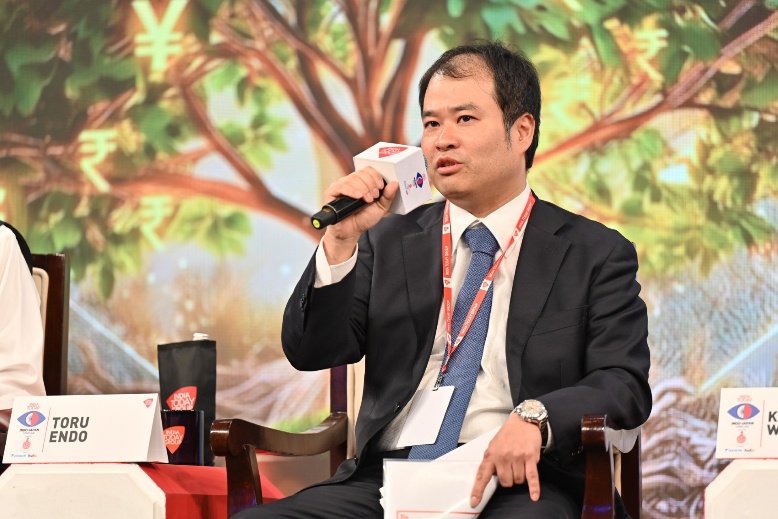
The Japan Bank for International Cooperation (JBIC) participated in the Third Edition of the Indo-Japan Conclave held by India Today, a leading local media group, in New Delhi, India. The event was organized with the aim of further deepening Japan-India relations across a wide range of fields, including geopolitics, trade and business, and technology.
At the conclave, policymakers and experts from Japan and India spoke under the theme “India-Japan: The New Growth Corridor.” Against the backdrop of geopolitical shifts and the reorganization of global supply chains, participants discussed new growth opportunities and potential for collaboration across a wide range of fields, including technology, industry, and infrastructure, recognizing the growing importance of the strategic partnership in the Indo-Pacific region.
ENDO Toru, Chief Representative of the JBIC Representative Office in New Delhi, participated in a panel discussion titled “Investments: Widening the Japan-India Investment Pipeline.” He noted that JBIC, as a policy-based financial institution wholly owned by the Japanese government, has mobilized approximately USD16 billion for India over the past five years. He also stated that JBIC would actively promote support for strategic sectors, including semiconductors and critical minerals, through the Japan Strategic Investment Facility launched in October 2025. He further highlighted the importance of fostering India’s semiconductor industry from the perspectives of strengthening economic security and diversifying supply chains. In this regard, he pointed out that alignment with global standards is key to building a robust semiconductor ecosystem. As an example, he added that it would be necessary to grant special economic zone status to the Dholera Industrial Area, which is being developed as a semiconductor manufacturing hub by the National Industrial Corridor Development Corporation, jointly funded by JBIC and the Government of India.
As Japan’s policy-based financial institution, JBIC will continue to actively support the overseas expansion of Japanese companies and the improvement of investment environments by leveraging its relationships with governments, government agencies, and local think tanks in host countries.