-
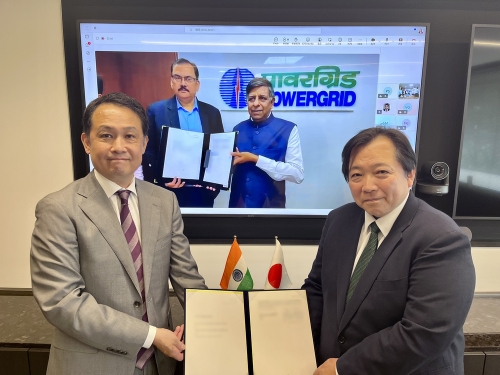
The Japan Bank for International Cooperation (JBIC; Governor: AMAKAWA Kazuhiko) signed on June 17 a loan agreement amounting to up to JPY80 billion, of which JBIC's portion is JPY48 billion, with Power Grid Corporation of India Limited (PGCIL), India's state-owned transmission company. The loan is co-financed with Sumitomo Mitsui Banking Corporation, Kansai Mirai Bank, Limited, Kiraboshi Bank, Ltd., and The Joyo Bank, Ltd. JBIC will also provide a guarantee for the portion co-financed by the private financial institutions.
-
The loan is intended to provide PGCIL with the funds necessary for a high-voltage direct current (HVDC) transmission project in India as part of GREEN operations
*1. This project involves transmitting electricity from the Khavda Renewable Energy Park in the state of Gujarat, western India, to Nagpur in the state of Maharashtra, central India.
-
India faces an urgent need to reduce dependence on energy imports and address climate change. In response, the government of India has positioned the expansion of renewable energy as a cornerstone policy, not only for reducing greenhouse gas emissions but also for enhancing energy self-sufficiency by lowering reliance on fossil fuel imports. It has set a goal of increasing renewable energy capacity to 500 GW by 2030. To achieve this target, transmission networks linking power generation sites with consumption areas are essential, and the government plans to develop 191,000 circuit kilometers
*2 of transmission lines by 2032.
-
In addition, PGCIL, the only state-owned transmission company and largest transmission utility in India, plays a strategic role in the development of the country’s power sector and serves as a core transmission service provider supporting the realization of the government’s renewable energy targets. This project is one of the world’s largest HVDC projects and is an important initiative underpinning the government’s renewable energy goals.
-
Considering the current situation in the Middle East, the government of Japan launched the “Partnership on Wide Energy and Resources Resilience Asia (POWERR Asia)” in April 2026 and is enhancing cooperation with Asian countries to strengthen the resilience of energy supply chains. India is not only a leading Global South country but also a like-minded partner in the Quad that plays an important role in realizing the Free and Open Indo-Pacific (FOIP). In addition, Prime Minister Modi has indicated the need to strengthen renewable energy supply systems and secure alternative energy sources in light of disruptions to fuel supplies amid the situation in the Strait of Hormuz. The loan will support the development of core infrastructure in the country, thereby contributing to strengthening and diversifying energy supply systems in Asia.
-
Support for this project will promote the adoption and expansion of HVDC equipment in the Indian market, which plays a core role in strengthening power transmission networks. It will also generate future business opportunities for Japanese companies in HVDC equipment supply and help establish a stable and sustainable supply chain.
-
As Japan's policy-based financial institution, JBIC will continue to provide financial support for efforts to preserve the global environment and address social issues, by drawing on its various financial facilities and schemes for structuring projects and by performing its risk-assuming function.